Catwoman. Have you seen this movie? It's so unrelentingly, aggressively bad. It's like the Showgirls of superhero movies. But it was on TV the other night, and nothing else was on, and the rain was, as they say, pissing down outside, so we weren't motivated to go rent something. And we were kind of sick of talking, which doesn't happen very often, admittedly, but even we have our moments. So we watched Catwoman.
Overheard in our living room:
"Why's she wearing a Starfleet uniform?"
"That's total crap. Cats can't play basketball worth shit."
"When does she take an 18-hour nap?"
"When does she stare at an empty wall for an hour?"
"When does she hock up a giant hairball?"
"I'd love to see Halle Berry hock up a hairball."
"They could sell tickets."
"I'd buy one."
"When does she lick her butt?"
"When does she claw the rug?"
"When does she claw the rug and then take a giant dump on it?"
"I hate this movie."
"I hate our cats."
Like many of you, I'm sure, I have this stubborn streak about wanting to be impervious to some aspects of our popular culture. I'll arbitrarily fix on some thing or person that the media is in a dither over and steadfastly choose to remain ignorant about it, no matter how many opportunities for watercooler chatter may pass me by as a result. And I'm a person who loves me some watercooler chatter.
Past examples have included Britney Spears, whose face I could proudly not have picked out of a line-up for some years. Ms. Spears's celebrity, alas, proved to be an unstoppable force that mowed down the immoveable object of my ignorance. Or something like that. But I tried, goddammit, I tried.
Likewise the Bill Clinton-Monica Lewinsky scandal. Did I want to know what he did with that cigar? No, I did not. I really, really, really did not. For days, weeks, months, I did the visual equivalent of putting my hands over my ears and singing "LA-LA-LA-LA-LA-LA-LA!" every time a newspaper or website tried to sneak up on me with that particular tidbit. But to no avail. It took a while, but popular culture, she is an insidious bitch.
But I'm always optimistic about these things, which is why, when the television and internet first started muttering about one James Frey, I had high hopes that I could continue to wallow in the mire of ignorance that is my natural milieu. Ha. HA. Without ever reading an article, watching a TV report, or talking with an actual human being about Frey, here are thirteen pieces of information that have seeped into my reluctant brain via some sort of vile cultural osmosis:
- James Frey is a writer.
- He wrote a book.
- The book is called A Million Little Pieces.
- The book purported to be a non-fiction account of the life of a hardcore drug addict who made good. (All together now: "Awwwww...")
- Oprah read this book.
- Therefore millions of people bought and read this book.
- Then they all learned that the book was made up.
- Everyone got mad.
- Oprah got really mad.
- Oprah invited Frey on to her show and scolded him.
- He gave some excuses.
- Oprah is still mad.
- More books were sold.
This is what I know. Do I care? No, not much.
I mean, I could analyze this scenario in detail and go on and on about how, on one hand, what Frey (and quite possibly his publisher; what role did they have in this?) did was dishonest, but how, on the other hand, it was understandable that they did it given that, these days, non-fiction is flying off the shelves faster than fiction.
And then I could go back to the fact that marketing this book as non-fiction was a pretty cynical move, but when you think about it, pretty much all media marketing is cynical. And then I could counter-argue that maybe that's true, but for some reason, even in this young yet jaded century, people are still idealistic about books, that they believe that writers and books and publishers somehow conform to a higher standard of honour than newspapers and movies. And I could smirk derisively and say, "Well, that's pretty naive, now, isn't it?" But at the same time, I'd sort of be agreeing with those people because I, too, have always considered books better -- in the fullest sense of the word "better" -- than any other media.
And then I could go back to my corner, mop my brow, confer with my manager, and come out swinging at the people who read Frey's book and are pissed that it wasn't "real." What's wrong with you? I'd ask. Isn't good writing enough for you? Aren't you happy that all these horrific things didn't actually happen in real life? Aren't you amazed and impressed that someone has this rare gift that lets him write so convincingly about things that he made up inside his own head? Don't you know that the best fiction is "real" in that it's even realer than real? And don't you know that all non-fiction becomes fictionalized in the process of passing through the filter of its author's mind? Is your high-minded anger at being denied in your quest for "objective truth" just masking your hunger to look under people's gory bandages and watch them vomit blood for an audience?
And I'd wonder to myself, what if Frey writes another book and frankly declares it fictional, and what if this book is amazing and has the power to inspire and change people's lives or at least temporarily elevate their souls as all great novels do, and what if nobody reads it because they still have sour grapes about his first book, and no one gets to have this transformative, transcendental experience, and Frey says to himself, "Shit, I should've said this book was true, too."
But I'm not going to write about all that. If people can't figure out these things on their own, they're not going to feel like hearing it from me. So instead I'm going to dig my cubbyhole a little deeper, retire to it, and wait and see what new, unwanted pop-culture meme manages to find me here.
Before I even get started, I want to go on record as saying that I really enjoyed the book I'm about to review, as evidenced by the fact that I read it in three days (which is fast for me these days). But, while I hate to split hairs, this novel ultimately fell a bit flat for me.
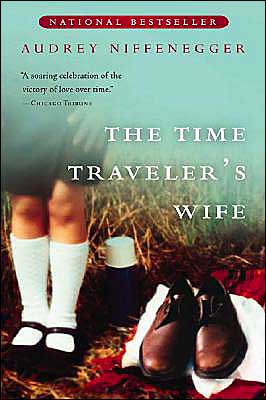
The Time Traveler's Wife by Audrey Niffenegger (#3)
 First, let me tell you what I loved about The Time Traveler's Wife.
I loved the premise: one of the main characters, Henry, has a genetic disorder called Chrono-Impairment that results in him frequently becoming "dislocated in time." In other words, he inadvertently time travels, mostly within his lifetime but occasionally outside of it.
I loved that Niffenegger speedily and deftly explains away all the nerdy space-time continuum mumbo-jumbo that can bog down your average sci-fi story. Instead, she focuses on the story itself.
And I love the story itself. It's a love story, and I'm realizing something about myself, which is that I love love stories, so long as they're not of the Harlequin variety. The lovers are the time traveler, Henry, and his wife, Clare, who have been meeting in time since Clare was six and Henry was 35, but whose story in regular linear time begins when they are 20 and 28, respectively. Given Henry's tendencies toward temporal displacement, they meet at all kinds of other ages: when Clare is 35 and Henry is 30, when Clare is 18 and Henry is 43, when Clare is 82 and Henry is 40... you get the idea. In each meeting, sometimes Clare is the teacher, sometimes Henry, but the overarching idea is that, in a relationship, each person shapes the other until -- given enough time -- each becomes even more the idealized self that their lover sees. This is normal for any happy relationship, I think, but it's exponentially magnified in Clare and Henry's case.
Did that make sense? I seem to be having a hard time getting this idea out, though it's crystal clear in my head. If you managed to follow all that perfectly, good for you, because things aren't going to get any clearer ahead.
Now, here's where the novel fell flat:
One of the things I love about reading is the little movie screen that runs in my head with my version of the story playing... the Doppelganger cut, if you will. The problem with The Time Traveler's Wife (prepare yourself for the hair-splitting I warned you about) is that Niffenegger does an almost too-thorough job of providing all the filmic details. In fact, it wouldn't take much work to handily convert this book to a screenplay. At best, this merely deflates my own role in reading the book; I feel like my job is to sit back and visualize the story exactly as it's told to me, and nobody likes to feel unimportant. But at worst, Niffenegger follows some movie conventions that are somewhat jarring -- nestled as they are in a fairly original and compelling narrative -- in their triteness.
I twigged to all this with one telling comment Henry makes, referring to an all-black outfit that Clare has picked out for him as something straight out of a Wim Wenders film. That's when I realized why this novel had been giving me déjà vü, and why in fact I kept visualizing Nicolas Cage as Henry: this book is a lot like a Wim Wenders film. Well, Wenders by way of Hollywood... sort of like the City of Angels as opposed to Wings of Desire.
From the almost baroque descriptions of various elements of the Chicago cityscape that provide the story's backdrop, to the more baroque references to opera and classical music, which -- along with punk -- form the novel's soundtrack, it's easy to see movie adaptation as you move through this book.
Where the adaptation bogs down is in the unfortunately clichéd cast of secondary and tertiary characters: the precocious kid, the down-to-earth black cook who's more like a mother than Clare's own distant mother, the stuffy wealthy brother and father, the asshole jock, the sassy Korean neighbour who helps raise Henry after his mother dies, and so on. In Niffenegger's hands, and to her credit, you can almost forget that these are stock characters who are almost as predictable as the story's ending, which you can see barrelling toward you when you're about a third of the way through the book.
Now, I don't want to suggest that Niffenegger wrote her book in such a way to make it appealing to Hollywood. That idea is cynical and unfair. What I think is more likely the case is that the author is a product of her times, as we all are, and our times are dominated by movies and television. It's probably not surprising that these are powerful influences when one is trying to tell a story. Crackpot theory? I don't know. Discuss.
The unfortunate consequence of all these seemingly small, nitpicky details is that, collectively, they shanghai what could be a great story, possibly one for the ages, and reduce it to merely a really good story. But all that said, I'd still recommend this book to anyone who, like me, has a jones for unconventional love stories. Because even if it's not a great story, it's still a really good story.
I put the "Er" in "Erratum": It seems I got the date wrong and won't be on TV tonight. The episode airs next week. My apologies to everyone who was planning to watch... all two of you. And now back to your regularly scheduled internet.
....................
So, hey, I'm going to be on the tube tonight next Thursday, February 2nd. All you lucky recipients of the CBC Television broadcast signal can catch a five-minute segment featuring me! me! me! on a show called Zed Tunes sometime between 11:30 pm and midnight.
The segment is called "Now Hear This" and the premise is that they take my entire (highly questionable) music collection away, submit it to analysis by a music expert, then hook me up with some new tunes courtesy of an awesome local music store. Kind of like Pimp My Ride, but with music instead of cars. And no Xzibit, alas. (He doesn't know it yet, but we were meant to be together.)
This segment won't just make you laugh and cry and say, "It's better than Cats!" It's also educational, especially if your CD library currently contains a lot of Duran Duran, Peaches, Peggy Lee, Marvin Gaye, and early Sasha, and you've been thinking it's time to maybe branch out in some new directions.
The segment also features young Master Sam extensively, because babies need good beats, too.
But wait! There's more!
While I'm advertising my media whoredom, I meant to post this link a month ago. As a wise man once said: Doh!
It's an article Jessa Crispin (of Bookslut fame) wrote for The Book Standard about the 50 Books Challenge. She interviewed me, an actor named Steve Waltien, and Neal Pollack, and she mentions Largehearted Boy. Jessa also makes a case for why bookstores should get behind the Challenge.
Time for a pop quiz!
Q: How much would I love to be sponsored by a bookstore?
A: A lot.
Okay, I guess two media appearances in a month doesn't make me a media whore. Yet. Just wait till my secret sex tapes come out.
You think you know somebody, and then they spring on you the fact that they read Jonathan Strange & Mr. Norrell months ago and didn't tell you.
Okay, I knew Rusty was working at Jonathan Strange, or so I deduced from the book's increasingly abused-looking spine (Rusty's one of those people), but to my discredit, I sort of assumed he wouldn't finish. He's a finicky reader, is Rusty, and if a book doesn't grab him and keep him, he has no compunction about cutting it adrift. Except for his fifteen-year obsession with Ulysses. So I kind of figured that Jonathan Strange was Rusty's new Ulysses.
But no, apparently he finished it ages ago. And he thought it was A-OK, something he stressed when he was pushing the book on me the other day. Well, his actual words were, "You'll like this. It has all that 19th-century bullshit you like." But you catch the meaning.
Now, here's the thing: I've never really had a hankering to read Jonathan Strange & Mr. Norrell. By all accounts, it's tough slogging for the first couple hundred pages, and while I've only eyeballed the book from a distance, I think there are at least a few more pages to read after those. Is it worth it? You tell me. But warn me if I need to change the title of this site to "20 Books", okay?
You know how, when you're eating an outstandingly delicious meal, you find yourself reminiscing about other outstandingly delicious meals you've eaten? And the entire dinner conversation turns into you and your companions egging each other on to greater and greater heights of gustatory ecstasy?
That doesn't happen to you? You have my pity. But there's hope for you yet! Read on.
An Alphabet for Gourmets by MFK Fisher (#2)
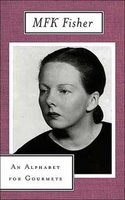 I love food. I love food writing. Why it took me so long to read MFK Fisher, I have no idea. But I've just finished An Alphabet for Gourmets, and I can only describe myself as satiated. Of course, I'm also eating a Cadbury Easter Creme Egg as I write this, which may be a contributing factor. Honestly, what do they put in these things... crack?
Extensive background on Fisher (1908-1992) can be found here, but suffice to say for our purposes that the woman knew food and didn't mince words about it. Imagine, if you will, the cutting wit of Dorothy Parker married to the innate sense of being right of Miss Manners, and imagine this precision lens applied solely to the art of cooking and eating. That's about as good an analogy as my modest descriptive powers will allow.
As you may have guessed by the nature of my site, I love a good structural conceit as much as, if not more than, the next person, so I was predisposed to love this book. Each essay in this collection is arranged alphabetically, beginning with "A is for dining Alone" and ending with "Z is for Zakuski" (Russian hors d'oeuvres).
One of my favourite chapters was "J is for Juvenile dining" in which Fisher expounds on her wish that her young daughter will develop a broad and educated palate, as a necessary ingredient in a happy life. I can relate. We tend to give young Master Sam a tiny taste of whatever we're eating, which is why, at the age of nine months, he's sampled more exotic foods -- from dahl to wasabi mayonnaise to homemade pasta -- than I had until I was 30.
Not surprisingly, I also loved "L is for Literature":
There is no question that secondhand feasting can bring its own nourishment, satisfaction, and final surfeit. More than one escaped war prisoner has told me of the strange peacefulness that will come over a group of near-famished men in their almost endless talk of good food they remember and wish to eat again. They murmur on and on, in the cells or the walled yards, of pies their sisters used to make for them, and of the way Domenico in Tijuana grilled bootleg quail, and of the pasta at Boeucc' in prewar Milan. They swallow without active pain the the prison's maggotty bread and watery soup, their spiritual palates drowned in a flood of recalled flavor and warmth and richness.
Isn't that gorgeous?
I also loved "P is for Peas" whose success can be measured quite simply in that it gave me a (as-yet unsatisfied) longing for fresh peas. They'll be in season again in... when? June? Dang.
The entire time I was reading this book, I was taken by memory after memory of foods and meals I've eaten, and I was amazed at how certain foods have become irrevocably linked to certain times and places. I can't think of liverwurst, for example, without remembering how Rusty and I used to sometimes bail out of our afternoon classes fifteen years ago, early in our courtin' days. We'd go to an excellent deli near my place and grab veal schnitzel sandwiches and liverwurst and crackers and Swiss chocolate bars, and we'd take this feast and, if it was a warm day, we'd eat it on the flat roof outside the kitchen window in my attic apartment. What we did for the rest of the afternoon is none of your beeswax.
Or if you were to ask me what the best meal I've ever eaten is, I wouldn't even hesitate to answer. A few years back, our housemate, The Don, gave us a generous gift certificate to this restaurant. Seeing the amount, we immediately insisted that all three of us could go together. The Don laughed knowingly and told us we should aim to go by ourselves and that, at best, his gift would merely take the edge off our bill. He was right, but man oh man, what a meal it was. It was a four-hour dinner service from a prix fixe menu, and while I couldn't tell you any of the individual dishes we were served, I can tell you that everything was magnificent. The food. The room. And the service! I finally understand all the fuss about European-style service!
More important, I finally understand all the fuss about posh restaurants in general. It's not about having an awkward experience with unfamiliar food in a stuffy environment, all for the purpose of showing yourself off to the other patrons and proving some arcane point to yourself. No, it's about the fact that lovely food served impeccably and benevolently in a beautiful room with a person you like (extra points if it's a person you love) at a slow, considered pace does something to you. You become expansive. You beam at each other. You talk. You listen. You become wittier, and you grow in your appreciation of your companion's wit. Your environment takes on a gentle glow that may or may not be caused by the carefully selected glasses of wine you're drinking with each course.
Good food served in good company transforms us, if only temporarily, into our best, idealized versions of ourselves. In short, it makes us better people. Unfortunately, we don't always have three hundred clams to lay down to remind ourselves of the existence of our perfect döppelgangers, but at least there are writers like MFK Fisher who can transport that person here at any time and place, and at a fraction of the cost.
It's election day here in Canuckistan. Why do I have déjà vü? Oh, because we just did this a little over a year ago. Kee-rist on a clamshell.
Yeah, yeah, yeah... I understand that the Liberals fucked up and all, but given that the polls indicate that Canada's seemingly collective desire to vote punitively will result in a Conservative government, this seems like one of those "the cure is worse than the ailment" scenarios.
The Conservative Party. Can you friggin' believe it? For you non-Canadians playing along at home, the current Conservative Party is the net result of an unexpected chain of events, which went roughly like this:
- The Progressive Conservative (PC) Party (not to be confused with the current Conservatives, the PCs were fiscally conservative but socially whatever-the-hell-the-people-want) withers away to nothing in the early '90s.
- The Alliance Party -- a bunch of Yankee-style neo-cons -- is founded by crankypants Preston Manning, who, if nothing else, at least gives all appearance of being sane...
- Unlike his later counterpart, Stockwell "Doris" Day, who's a few maple trees short of a grove, if you catch my meaning. (Go here to read all about comedian Rick Mercer -- who's sort of Canada's Jon Stewart -- and his referendum bid to get Day to legally change his name. Funneeee.)
- And then, as if from nowhere, the new Conservative Party rises from the ashes of the old Alliance Party. It's an uneasy merging (well, it makes me uneasy, anyway) of fiscal conservatives and social conservatives, led by the small-eyed Stephen Harper.
You know what they say in Canada: if you don't like a political party, just wait five minutes for it to change.
Anyway. This unlikely group is careening toward victory, which would all be well and good except that they have some funny ideas (and not ha-ha funny) about things I care about, such as gay rights and staying the fuck out of Iraq.
Don't get me wrong. I'm not all that keen on ANY of the main parties in this election. A rundown:
Liberals: They lied and they stole. These are bad things. They fucked up. And voting them in again would seem to endorse their fuckuppery.
New Democratic Party (NDP): Any liberal thinker worth their salt must support the NDP's platform -- improved social programs and whatnot -- but does any thinker of any political stripe actually believe that the NDP has the experience and moxie necessary to make their platform a reality?
Conservatives: Don't get me started. Again.
Bloc Quebecois: This Quebec-based party is ostensibly pro-separation. I'm one of those people who likes to keep the family together and happy, but these days I can't say I blame the Bloc. If the Conservatives do win, I want to separate.
Out here on the ol' frontier, we've also got a bunch of crazy fringe parties, to boot: the Green Party, the Work Less Party, the Marijuana Party, to name just a few. While in theory, I think that these are all worthy and noble goals, they strike me as a bit, er, single-minded. (And yes, yes, I know that these parties all purport to have broader mandates; you don't need to tell me! But if their mandates are really all that broad, maybe it was a strategic mistake to have such a singularly focused party name, hm?)
So where does that leave me? Well, I'm not going to tell you how I'm voting. I had a traumatic experience in grade three, when our teacher asked us -- via a show of hands -- how our parents were voting in the federal election. I was the only person whose hand went up when she said "Pierre Trudeau." Oh, the schoolyard ostracism!
But I am definitely voting. As should you. And let me tell you something: it's not too late for you to vote today, EVEN IF YOU'RE NOT REGISTERED IN YOUR RIDING. Go here (I couldn't get the permalink to work, so just go to the entry entitled "Peace, Order and Good Government Doesn’t Come Free") to get all the poop on how to register, where to vote in your riding, and of course learn about the candidates.
[Big ups to CBC Radio 3 for the link and the info]
Ack! No long post today. I pulled a neck muscle while lifting young Master Sam last week, and it doesn't seem to be healing. It hurts like a friggin' mofo, and it's exacerbated by two things: carrying Sam and hacking around on this here computator. And since I can't forego carrying Sam, you see where I have to make my sacrifice.
Hopefully, a three-day weekend will heal me up good. See you on Monday!
In the meantime, a little something to ponder:
The fantastic thing about this site isn't that it lists all these great paperback cover artists and provides all kinds of interesting background information about each one, such as this snippet about James Avati, the "greatest cover artist of them all":
He was a Fifth Avenue department store window display designer, a soldier in World War II, and an illustrator for magazines such as Collier's and The Ladies' Home Journal before breaking into paperback illustration in 1948.
No, the fantastic thing about this site is that it's all about cover art, and yet it manages not to show any of it.
Oh sweet jesus, I've just found my new favourite site, and quite possibly my favourite site of the decade.
I love animals. I love snarky writing. De facto, I love Just a Little Guy. It's like Go Fug Yourself meets National Geographic meets I don't care because it's so fucking cute and funny.
To wit:
This is like the birds and the bees scene in cartoons. Little hearts floating up over their heads and popping. Plink. Plonk. And they rock back and forth to some song from the fifties. "Moon River" or something like that.
 The one on the right looks like he's about to fall off. He's just barely got a grip with his toes and his ass is hanging waaaaay off the back of that stick. Whoops, falls backwards grabs his friend and they both plummet to their bloody death right? Wrong, douche! These are Momonga, the dwarf Japanese Flying Squirrel. They can fucking fly.
Why are you still here? Go!
[Link via CBC Radio 3]
Lying in bed between your sleeping husband and baby, all of you snuggled beneath the duvet, with the nightlight casting a glow over the pages of your book: this is the sweetest way to read.
Lying in bed between your sleeping husband and baby, all of you snuggled beneath the duvet, with the nightlight casting a glow over the pages of your book: this is the most maddening, annoying, and hellishly uncomfortable way imaginable to read.
First off, it's hot. Not just regular hot. Boiling hot. All three of us are conduits for some kind of elemental force that emanates heat in ripply waves like those you see on desert horizons. Separately, we don't notice it. Together, we could pop the top off a thermometer and make mercury rain down on the room. If mercury rain will cool me down, I'll take it.
And why am I the one who has to lie in the middle? Why? Because Rusty likes to pull the covers up over his ears. Young Master Sam likes them only on his legs. I am the unofficial nocturnal blanket wrangler whose job is to keep everyone covered according to their proclivities. As a result, in true Mama Bear fashion, the covers on me are neither too low nor too high, but instead rest just over my sternum. The thing is this, though: I hate blankets and would prefer none at all.
Which brings me back to point A: I'm HOT.
Also, our nightlight sucks. I'm going to go blind like John Milton, without the benefit of loyal daughters who will type my blog entries for me when I'm old, and I'm going to have no problem pinpointing what caused it. But if I increase the brightness by even five watts, Sam's eyes pop open like little blue jack-in-the-boxes and dear god in heaven, we don't want that. So 15 watts it is. And I'm putting aside a dollar a week to save up for for my seeing eye dog, because it's pretty obvious to anyone who's met him that my dog, Dobbs, is not a creature you want leading you across six-lane intersections.
So picture me, if you will -- cramped, sweating, squinting, horribly contorted so as to position my book to get maximum light exposure -- and add the fact that I'm turning each page incredibly s-l-o-o-o-o-o-w-l-y so as not to disturb either Rusty or Sam. They can be twitchy when disturbed.
I've read literally thousands of pages in this manner. I must love reading, huh?
The thing is, I don't just love to read: I have to read. Bedtime reading is such an engrained habit -- a habit 30-plus years in the making -- that no matter how tired I am, I can't fall asleep without reading a few pages, or sometimes even a few sentences. Without a book, I'll just lie there in the dark, my dry, exhausted eyes twitching in their sockets for hours, waiting to succumb to forces that apparently take almost everyone but me to sleepyland on a nightly basis.
Many years back, I hopped aboard a Green Tortoise tour of Baja. If you're not familiar with the Green Tortoise approach to travel, here it is: a bunch of young-ish people hop on a custom-renovated hippie bus that serves as a tour bus by day and a hostel on wheels at night. At dusk, all the travellers pull out from their luggage only the necessities they'll need for the night. Everything else gets packed -- irrevocably -- under the converted sleeping platforms until the next morning.
You see where I'm going? Yes. I accidentally stowed my books overnight. All my books. The thudding horror I felt when I realized this was close kin to the sick feeling you get in that dream where you arrive at the airport only to realize you've forgotten your ticket and passport.
I had a similar experience a few years back, when Rusty, our friend Ali, and I went on an overnight hiking trip. Our plan was to do an approximately four-hour hike up to a lake in a glorious alpine meadow, where we'd pitch camp, cook dinner, ingest some fungi that may or may not have possessed magical properties, and in general lark about, get a good night's sleep as only comes after a day of vigorous activity in the mountain air, then break camp and hike back down the next day.
Here's a chronological list of everything that went wrong:
- We arrived at the trailhead late. I don't like to point the finger of blame, but Rusty and Ali do, and they pointed it at me. I'm sure I must have had my reasons.
- It being a hot day, Rusty applied himself rigorously to lightening our packs so that we could get to our campsite more quickly. Said load-lightening included abandoning my book, after much protest. ("Why do you need a book? You'll be hanging out with us!")
- Rusty accidentally (he claims) lightened our load to such an extent that he left behind our spare water, our Kool-Aid powder (for flavouring the creek water we also expected to avail ourselves of), and the bug repellent.
- We realized, after three hours of gruelling, spectacularly unpicturesque switchbacks, that we'd misread the trail map (and by "we" I mean Rusty). Our expected 1500-foot elevation gain suddenly morphed into a 1500-meter elevation gain. You don't have to be European toknow that a meter is much longer than a foot.
- The day got hotter.
- The switchbacks continued mercilessly.
- The creek was dry. As a result, water was rationed.
After eight hours of almost ceaseless uphill hiking, we were on the verge of heatstroke. (Did I mention that we'd all been up almost all night the night before, doing what is referred to in the parlance of our times as "partying," and as a result were rather fatigued and dehydrated at the start of the hike? How did I manage to forget that?) So we decided to bail on the alpine lake and just park our tent on the closest thing approximating level ground we could find.
Being young, optimistic and, most fundamental to this story, stupid, we didn't just call it a day, pitch our tent on its 75-degree incline, sleep, go home, and pretend the whole thing hadn't happened.
Instead, we established our camp and then nonchalantly imbibed the aforementioned fungi with the alleged magical properties. And a good time was had by all!
No, that's not true. What actually happened was that within ten minutes of choking down our evil, dusty, dirt-flavoured handfuls of spores, Rusty and Ali fell deeply and immovably asleep. I say "immovably" because I pinched them -- hard -- and they did not move.
So where did that leave me? I'm glad you asked. Here's a recap of things I did not have:
- water with which to slake my exponentially growing thirst
- a book with which to amuse myself
- bug repellent, which would have protected me from the angry mobs of mosquitoes I could hear congregating outside our tent
- loyal friends
- a club with which to bash myself on the skull repeatedly in the hope that it would render me blissfully senseless
Here's what I did have:
- a creeping restlessness and sense of dread facilitated by the foul plant toxins now circulating recklessly throughout my body
- our hiking guidebook
So I did what anyone in my situation would do: I lay on my sleeping bag and read that entire hiking book from cover to cover. I took special delight in bookmarking specific hikes to show Rusty later... hikes with minute elevation gains that rolled lazily through mountain vista after mountain vista, with sparkling water sources aplenty.
And that is the worst camping trip I've ever been on. And I've been on some doozies. Like the time years and years ago when Rusty and I got into a stupid argument and a horsefly wouldn't stop dive-bombing me in our canoe, so I burst into tears, which won Rusty's sympathy if not the horsefly's. (Horsefly schmorsefly. Someone should rename those things jackassflies. Ha. Geddit?)
Or there was another camping trip where Rusty, Glark and I realized that our tent was missing its fly... after we'd already canoed five hours to get to our campsite. It's very dumb not to check your gear before you go camping, a message that God (or whatever vengeful entity you choose to believe in) reinforced by sending a full night of thunder and torrential rain our way.
But that wasn't even the worst part. The worst part was that Rusty made chili for dinner, a meal that served to make Glark's bowels explode all night long like some kind of Wile E. Coyote Acme fart generator, a smell rivalled only by Rusty's noxious pre-wisdom-teeth-extraction breath, which under normal circumstances I would have said smelled like ass, except that Glark was there to remind me what ass actually smells like, and the two bore no relation to each other except for their equal roles in causing me to try to drown myself in the three inches of standing water in our tent.
Jesus Christ, how did I get here in this entry? You people have to STOP ME when I get like this. I have a BABY to take care of.
What the hell was my point? I guess all this is by way of saying that my current reading environment may not be the most comfortable, but I've endured worse. Yup.
Young Master Sam is 39 weeks old today, which means he has officially spent more time outside my body than inside it. And speaking of rocky, painful passages from inside to outside, perhaps it is fitting that Sam, for the first time in his young life, has just experienced something I'd delicately and euphemistically refer to as "a logjam up the river".
I'm not going to blog about it here because this is a site devoted to higher thinking, proper elocution, and company manners. No, if you want to read the entry in which the word "poop" appears in greater density than anything I've ever written, you're going to have to mosey over to my latest entry -- subtly entitled "Nggggghhh! NGGGGHHHAAA!!!" -- at the Bored Housewives Network.
Also, a Best of Blogs update: I was ahead in the popular vote, but now I'm in third behind two extremely strong contenders. Do with this information what you will.
For the past ten years, I've believed that I'd already read Douglas Coupland's Polaroids from the Dead. It turns out I was wrong.
Polaroids from the Dead by Douglas Coupland (#1)
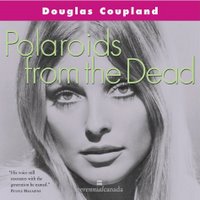 I think I can reconstruct the chain of events that led to my misapprehension. First, Generation X came out. I read it before all the hype, loved it, and waited eagerly for his next book, Shampoo Planet. Liked it a lot, but not as much as Gen X, but that's okay. Fast-forward a couple of years. Read Microserfs and dug it more than Shampoo, which prompted me to rush out and get Life After God, which was so terrifically meh that I didn't pick up any of Coupland's new books for ten years. I had officially surfeited on the alleged voice of my generation.
In retrospect, I think I came to believe that I'd read Polaroids around the same time as Life After God, since they're both collections of short writing. Fortunately for me, Polaroids (which actually came out in 1996, two years after Life After God), is a much better book.
The title refers to the first dozen pieces in the collection, a series of snapshots and character studies of the denizens of the temporary community created at a Grateful Dead concert. The remainder of the book is comprised of personal essays on topics ranging from O.J. Simpson and Nicole Brown to Kurt Cobain to Coupland's platonic crush on the Lions Gate Bridge, which goes from downtown Vancouver to the suburb of North Vancouver. (I can appreciate his appreciation on aesthetic grounds. It's a beautiful bridge to look at. To use, on the other hand, it's an absolute nightmare. Occasional high-spirited ranting aside, I'm not normally an angry person, yet the Lions Gate Bridge has, on almost every occasion I've used it, catapulted me into a transcendental state of rage.)
All the essays in Polaroids were written by Coupland in the second half of the 90s, looking back on the first half of the 90s. Visiting these essays exactly a decade later provided a nifty little temporal frisson that recurred for me throughout my reading. There's something so incredibly, exactingly in-the-moment about Coupland's writing that makes it seem dated within 0.3 seconds after it's published. And yet this quality is what I like more and more about reading his early work. It brings out my inner Margaret Mead.
Some random thoughts:
I wonder if part of the reason why so many of us feel a knee-jerk compulsion to disparage Douglas Coupland is because he writes so nakedly about trying to figure out the meaning of life. As if watching someone baldly and publicly ask these questions embarrasses us, kind of like watching your dad dance. As if wondering about the point of existence is all well and good when you're an earnest undergrad but a little, you know, off-putting when you're in your 30s.
I know that many people resent Coupland because they believe that he arrogantly overgeneralized and oversimplified an entire generation. But then take this passage from Polaroids:
"Cheer up, baby. Come on. Embrace the meltdown." Then, pleased with himself for catching the drift of her lecture, he adds, "We're the McDead."
"Yes," says Caroline, dreaming of another world where complex issues refuse to masquerade as oversimplicities, "we're the McDead."
I love Coupland a little bit for that snippet of writing.* It's such a deliciously subtle, casual "fuck you" to the critics who seem determined to misconstrue his writing.
It's always seemed to me that Coupland has spent the years since Generation X trying to cram the idea in people's -- and by "people" I mean mainstream book reviewers -- heads that he wasn't the person who tried to oversimplify an entire generation: they were.
I was definitely guilty of hopping on that bandwagon at the time, but I gradually became aware that I'd misdirected my resentment at being summarily categorized and dismissed, and I've since taken steps to point said resentment in the right direction: at the stupid mainstream media that seized a few of Coupland's ideas and made them into some of the most flagellated talking points of the late twentieth century.
Coupland does, of course, create his own lexicon, which lends itself all too readily to abuse. But in my opinion, this is less about oversimplification and more about creating shortcuts to understanding our ridiculously complicated zeitgeist.
A potentially helpful analogy (though I'm not making any promises):
An old friend of Rusty's is a doctor. Not the fun prescription-writing kind, but the kind who's good at math and teaches at universities. This guy's area of specialization is bioinformatics, which, as I understand it, is the study and practice of inventing computer code that allows massive chunks of data -- so massive that they could never be processed in real time in our lifetime -- to be processed and analyzed in shortcuts. This is particularly handy for endeavours such as the Human Genome Project (which Rusty's friend worked on for several years). I would argue that Coupland's lexicon -- his knack for identifying cultural and social forces and summarizing them in soundbite-y snippets -- is almost equally useful in helping Coupland (and his readers) find shortcuts for understanding the wide-sweeping vagaries of 21st-century western human behaviour.
It's a theory, anyway.
Or maybe the reason why some people fear and loathe Coupland is because nobody likes being pegged neatly and aptly by someone who doesn't know them:
New Order sturates the warming car. Erik and Jamie have returned to a future they can live with: spare, secular, coherent and rational -- a future reflecting their own puritanical belief that excess is its own punishment.
Sound like anyone you know?
Others, of course, castigate Coupland for being flip and ironic and, well, Gen X-y. Methinks they doth project too much. Take a gander at this passage, about how a hippie mom relates to her now-adult hippie daughter:
Despite the obliqueness of her reply, Melissa couldn't help but regale Columbia with endless tales of that long-gone era: tales of gardens and horses and moonlight and tear gas and beards and electricity. And from these tales, Columbia knows that at the heart of the sixties dream lies a core truth, a germ that refuses to die, an essence of purity and love that is open to abuse -- and continually abused -- but without which Columbia could not live her own life peacefully.
If there's anything flip or ironic there, I can't see it. Coupland strikes a similarly soft and forgiving note in another essay, "The German Reporter," when he observes that "middle-class peace is something to be cherished, not mocked, because without it, we are lost, and we are only animals and never anything more."
Douglas Coupland, semi-official voice of the slacker generation, saying nice things about hippies and the middle class? Is this the Coupland you thought you knew?
Oh, he can still be flip and ironic. The thing about Coupland is that he's a whole bunch of things: disaffected, affected, navel-gazing, didactic, self-contradictory, pretentious, detached, embarrassingly earnest, and heartwrenchingly sincere. Just like you. And me. And I think that when we think about what we don't like about Coupland, we should think about that quality in ourselves, because it could very well be THAT that we don't like. And maybe it's time to be a little easier on ourselves. Life is short, dude.
*I also love him for his newest book, Terry: Terry Fox and His Marathon of Hope, which I haven't read yet, but don't see how it could fail to be moving and inspiring. As I get older and fall more and more away from my twentysomething tough cookie facade, I find that I like to be moved and inspired.
No new post today. Young Master Sam and I are going to be on TV (more details on that later), so when we haven't been taping this week, we've been in our trailer harassing starlets and demanding blue M&Ms. We'll be back tomorrow Monday, with one (and possibly even two or three) books under our -- er, I mean my -- belt.
If you want to learn how to write good, then you need to read George Orwell.
Or, say you're not a writer (I almost wrote "say you're not an aspiring writer," which is kind of a bullshit phrase because either you write or you don't. If you're an aspiring writer, what are you waiting for? A pen?), but you just want the tools to understand why you hate the writing you hate... then you need to read Orwell, too.
I'm not necessarily talking about his novels, though I've certainly read Animal Farm and Nineteen Eighty-Four my fair share of times and can recommend them, provided you were already planning on being depressed. No, I'm talking specifically about his essays.
I can actually hear noses out there crinkling in disgust. Ewww... essays. But how many times do I foist essays on you? The answer: never. So give it some thought.
If you only read one essay by Orwell, make it "Politics and the English Language", which serves the double purpose of being an instructional manual on how to write well AND an exposé on how sloppy writing -- and our acceptance of same -- allows politicians and their sneaky ilk to get away with their crap.
Before we get to that, though, some things you might not know about Orwell:
Before he was a writer, he was an editor.
Before he was an editor, he was a journalist.
Before he was a journalist, he was a cop.
This career path actually makes perfect sense. How many times, as an editor, have I wished I had the power of the law behind me to force good grammatical behaviour? Something I didn't know until I read this piece by Jeffrey Myers in The New Criterion* is that Orwell struggled with the transition from editor to writer, and that this struggle partially manifested itself in his compulsive need to write:
Orwell’s illuminating comments on his own work show how desperately he wanted to be a writer and how long he had to struggle to become one... Orwell, able to write four serious articles a week (or about 200 articles a year!), was a desperately driven and manically compulsive writer.
Orwell and I were separated at birth, apparently. Feeling shaky about morphing from editor to writer? Check. Manically compulsive? Check, and mate. We also share the same views on book critics:
He complained about the low standards of book critics and told his fellow novelist Anthony Powell, “the reviewers are awful, so much so that in a general way I prefer the ones who lose their temper & call one names to the silly asses who mean so well & never bother to discover what you are writing about.”
It makes sense that someone who came to writing through editing should have given the craft and process of writing some serious thought. As I've already mentioned, Orwell's 1946 essay "Politics and the English Language" (available online in its entirety here) is a plea for not-so-common sense in writing.
I'll kick things off with his gorgeously simple list of six rules every writer should obey:
- Never use a metaphor, simile, or other figure of speech which you are used to seeing in print.
- Never use a long word where a short one will do.
- If it is possible to cut a word out, always cut it out.
- Never use the passive where you can use the active.
- Never use a foreign phrase, a scientific word, or a jargon word if you can think of an everyday English equivalent.
- Break any of these rules sooner than say anything outright barbarous.
These rules sound elementary, and so they are, but they demand a deep change of attitude in anyone who has grown used to writing in the style now fashionable.
I'm not saying I'm not guilty of committing these sins on a daily basis, but in the years since I first read this essay, I've learned to watch for them, and when I do catch myself out, I abuse myself harshly. And believe you me, it's not easy for someone with my passion for a flamboyant turn of phrase to apply discipline to herself. I never stop being astounded by how easily hackneyed expressions creep into my writing, the insidious little buggers. (Point of note: "hackneyed expression" is, in and of itself, a hackneyed expression.)
Speaking of avoiding exhausted clichés, here's a fabulous passage from "Politics" that I've worked desperately to internalize. If you only take one idea away with you, consider making it this one:
A newly invented metaphor assists thought by evoking a visual image, while on the other hand a metaphor which is technically "dead" (e.g. iron resolution ) has in effect reverted to being an ordinary word and can generally be used without loss of vividness. But in between these two classes there is a huge dump of worn-out metaphors which have lost all evocative power and are merely used because they save people the trouble of inventing phrases for themselves.
You have to wonder how Orwell would feel if he knew that so many of the terms that originated with him -- "Big Brother," "newspeak," "doublethink" and, of course, "Orwellian" -- had been absorbed into the language and, may god have mercy on us all, were being widely abused by politicians and pundits. I'm glad he never had to find out. The poor man had enough troubles.
As long as I'm copying and pasting my favourite swathes of text... if you only take TWO ideas away with you, here's the second:
A scrupulous writer, in every sentence that he writes, will ask himself at least four questions, thus:
What am I trying to say?
What words will express it?
What image or idiom will make it clearer?
Is this image fresh enough to have an effect?
And he will probably ask himself two more:
Could I put it more shortly?
Have I said anything that is avoidably ugly?
But you are not obliged to go to all this trouble. You can shirk it by simply throwing your mind open and letting the ready-made phrases come crowding in. They will construct your sentences for you -- even think your thoughts for you, to a certain extent -- and at need they will perform the important service of partially concealing your meaning even from yourself. It is at this point that the special connection between politics and the debasement of language becomes clear. [emphasis mine]
The unspoken questions here are: do I actually have anything original or meaningful to say? If I cut out all the anaemic turns of phrase and fifty-cent words and general linguistic clutter, am I left with anything of substance?
But say the thought of kicking yourself in the ass (metaphorically speaking, of course) is just too taxing. Say you're thinking to yourself, Why doesn't everyone lighten up? It's just WORDS, fer chrissake. What are the political consequences of lightening up? Well, for one, it means nobody calls shenanigans on the ol' "Stay the Course" speech (coming up on its second birthday this spring), an insult to anyone with two brain cells to rub together.
Put that in your proverbial pipe and smoke it.
*Don't be alarmed. I haven't gone all right-wing or anything. This piece just had some interesting new (to me) biographical information on Orwell. I swear I'm not going to start selling "Bill O'Reilly Has a Posse" t-shirts on Cafe Press or anything... but if I did, would you buy one?
For those of you who just can't hear enough of my interminable stories about young Master Sam, I wrote this entry over at the Bored Housewives Network all about babyproofing and the perils of having a newly ambulatory baby.
(Question: Is it a coincidence that "ambulatory" sounds so much like "ambulance"?)
 Er, so it seems I'm a finalist for a Best of Blogs award in the Best Book and Literary Blog category. Thanks so much to everyone who nominated me!
This is my obligatory cue to urge you to vote for me, but I'll be durned if I can figure out how to do that on the BoBs site. Anyone?
 Scholastic Press has just announced the May release of a children's book called My Senator and Me, co-written by Senator Ted Kennedy and his Portuguese water dog, Splash.
The book offers a dog's eye view of the democratic process:
According to Scholastic, Kennedy's book "not only takes readers through a full day in the Senator's life, but also explains how a bill becomes a law."
So let's tally the checklist here:
- The Kennedys like books. I like books.
- The Kennedys are liberal minded. I'm liberal minded.
- The Kennedys have a Portuguese water dog. I have a Portuguese water dog.
I always knew we had something in common. Well, other than our patrician good looks.
There's a reason it's called the 50 Book CHALLENGE and not the 50 Books Breezily and Effortlessly Read in One's Wealth of Free Time. It's not enough that I'm dealing with young Master Sam and his own 50 Poop Challenge (a daily, rather than annual, event): there's also an entire World Wide Something-or-Other constantly tempting me away from my book du jour.
So, since I'm easily distracted these days, I thought I'd share my handicap with you. You're not doing anything else right now, are you? Be that as it may, here's a random sampling of my favourite web thingies, new and old:
Big Dead Place
Rusty turned me on to this site quite a while back. He's probably read every single word in it, and he's the Mikey of the internet, so that's saying something. The big dead place in question is Antarctica, or, more specifically, the McMurdo Station at the South Pole, whence this site originated.
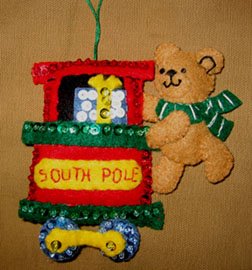
 You think you've got a lot of free time on your hands? You think I do? Compared to these guys, we are wet-behind-the-ears ama-teurs in the creative time-wasting department. Which explains entries like this one, a thousand-word critical analysis of a Christmas ornament. Unadulterated brilliance.
I would be spectacularly remiss if I did not mention that this site recently spawned a book -- Big Dead Place: Inside the Strange and Menacing World of Antarctica -- which is, by several accounts, quite good. The Times of London called it a "savagely funny... grunt's-eye view of fear and loathing, arrogance and insanity... It's like M*A*S*H on ice, a bleak, black comedy." Needless to say, I've already ordered it for Rusty.
Hello Tomorrow
I don't care if it's a TV ad, this spot that Spike Jonze directed for Adidas made me happy every time I caught it during its short broadcast life, so I sought it out online and bookmarked it. And now I watch it any time I have 90 seconds and want to give my brain a massage.
(For the record, I'm impervious to most TV advertising, which is due more to the fact that advertisers aren't targeting the tiny "weirdo" demographic to which I belong rather than to any inner strength of character I possess. I've probably watched this commercial a hundred times, and I still don't own anything by Adidas.)
Minimiam
I love the photo gallery on this site so much that I can even disregard the fact that it's a navigational nightmare to get to it. (I'm a usability snob. Yes, we exist.) First, you're presented with some arty French Frenchiness while the site loads. Then you click anywhere on the screen, causing the dots on all the "i"s in "minimiam" to fecklessly float away. Then the menu finally loads. It's in  French, but that's not your problem. Your problem is that it's one of those coy, flirty menus that likes to dance around -- again, in a manner I can only describe as "French" -- while you mouse over it.
But if you're diligent and possessing of solid hand-eye coordination, you can pin down the link that says "Galerie" and you're in. If you dig bizarre miniatures and luscious desserts and incredibly artful photography, it's well worth the trip.
Eugene Mirman
I started visiting this site a few years ago, when Eugene the Marvelous Crooning Child had only a half dozen songs under his belt. Now his playlist spans two pages. My favourite is still "Cat's in the Cradle" on this page. Listen to it three times and I promise you will not get it out of your head for weeks. Or months. Or... ever.
Wondertoonel
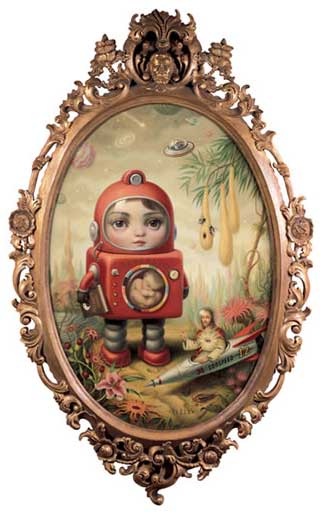
 These paintings by artist Mark Ryden blow my mind. I can't even imagine how breathtaking they must be in real life. Dark, surreal, fantastical, and painstakingly, meticulously executed... I could stare at these for hours and still find new details to marvel at. Check out the serenely haunting nude rendering of Björk in "Björk." And I think I once had a dream that looked a lot like "The Magic Circus." But my hands-down favourite has to be "Princess Sputnik" (pictured right).
For a fun -- and potentially disturbing -- audio-visual treat, might I suggest playing Eugene's songs in the background while viewing Ryden's paintings? Let me know how that works out for you.