Tuesday, October 31, 2006

BOOKS: The Horror. The Horror. Or Something.

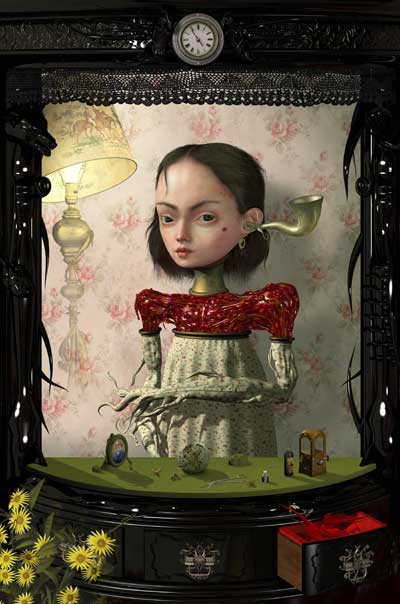
"Silent Whispers" by Ray Caesar
..........
I know, I know. It's Halloween, and by rights I should be writing about horror novels I've read and enjoyed. Except that we've covered this territory before, and you all know that, while I've had my flirtation with the genre, I've since became a delicate flower for whom horror novels are too, well, horrible for my delicate sensibilities.

But I can point you toward this article, which Rusty sent me:
Fans, and even a few brave academics, have argued that [Stephen] King's novels and stories, taken together, provide a composite portrait of late-20th-century American masculinity in crisis. They also point to his undeniable storytelling skills, his vast if somewhat lurid imagination and his gift for capturing American speech as proof of, if not literary greatness, then something more than mere hack work.

This question hit the media in a big way when King won the 2003 National Book Award for distinguished contribution to American letters. King's supporters, many of them such "literary" authors as Michael Chabon, said that it was about time that a writer of King's calibre was recognized by the literary establishment; many traditionalists saw the bestowing of the award on a mere horror writer as another example of the dumbing down of American culture.
Well. Lah-dee-dah. Can horror fiction be literature? Is Stephen King an important writer? I think I cared more about these questions a decade or so ago. I like King, and I love some of his earlier novels, particularly The Stand and The Talisman, but I honestly don't get this need to deem books "literature" or not. I like what I like. I don't like what I don't like. I really don't give a sweet rat's ass what category it falls into. And dude, if Stephen King's novels get people reading, I'm all for that. If it gets people digging up their dead cats and causing them to come back to life as evil doppelgangers? I do take an exception to that, yes.

So then I got thinking about the history of horror writing. I did a bit of digging around (thanks largely to this very informative site) and I learned some interesting stuff:

  • The 1580s seem to mark the first time horror stories found a public audience. "An incredible series of gruesome plays jostle each other on the stages of England," including Christopher Marlowe's Tamburlaine and Shakespeare's Titus Andronicus and Macbeth.
  • An episode of mass hysteria in the Austrian village of Medvegia prompted the government to commission a report on peasant customs. The report went into great detail about vampire activity in the area, and this information spread quickly, first throughout the scientific community and then through fashionable society. And vampires have been all the rage ever since.
  • The first Gothic novel is widely believed to be a book called The Castle of Otranto, written by one Horace Walpole. I've never even heard of this book! Just when you think you know everything.
  • If you've ever wondered how it is that the Japanese are so good at scaring the living crap out of us (don't believe me? You've clearly never watched the movie Audition. You do that and get back to me, okay?), it's because they've had a lot of practice. In 1776, a Japanese student of literature and critic named Uneda Akinari published a collection of "chilling and romantic" stories called Ugetsu Monogatari, or Tales of Moonlight and Rain. Some of the titles included are "The House Amidst the Thickets", "The Chrysanthemum Trust" and "The Carp That Swam in My Dreams", and if these stories are as innocuous as these titles suggest, then why the heck do I have goosebumps after typing them out?
  • In 1784, the Marquis de Sade wrote The 120 Days of Sodom, "the most impure tale that has ever been told since our world began" whilst imprisoned in the Bastille. De Sade's writing saw him persecuted throughout life. I've read some of his work. I don't feel that badly about it.
  • Everybody knows the story about how Lord Byron, Percy Shelley, Mary Wollstonecraft Shelley, and Dr. John Polidori were all staying at a villa by Lake Geneva when they decided to each write a ghost story, but did you know that it's now widely speculated that they were under the influence of laudanum when they did it? Man, if I had a head full of laudanum, I sure wouldn't sit around writing scary stories. Whatever happened to baby oil and a Twister board?
  • In 1819, Dr. Polidori's The Vampyre was published, making it "the first vampire tale of any substance in the English language." The lead character was a caricature of Lord Byron, which is pretty funny, if you think about it.
  • Edgar Allen Poe published his first story in 1833. He once described himself as "insane, with long intervals of horrible sanity." Dude, I totally know how you feel.
  • The first issue of Weird Tales, the first all-fantasy magazine in the world, came off the presses in 1923. The magazine somehow survived thirty-two years without ever showing a profit. Weird Tales attracted a small, fanatical audience, as well as noteworthy authors such as H.P. Lovecraft and Ray Bradbury.
  • We all know that some of Stephen King's novels have lent themselves fairly well to being made into movies (The Shining, Carrie); others, not so well (um, pretty much all the rest). But the absolute worst flop had to be the 1988 stage musical of Carrie, which lost its producers eight million dollars. That's right. Stage musical. Stop and take a moment to picture it.
I'm all trivia-ed out. But I can say this. If Ray Bradbury can get published in Weird Tales and still be considered a serious writer, I don't see why people are stymied over Stephen King. And man. Carrie: The Musical? Hasn't the poor man suffered enough? Cut him some slack.

Monday, October 30, 2006

BOOKS: Sex Libris*

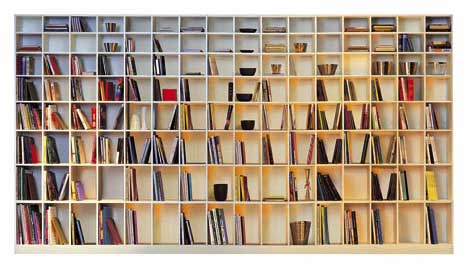
And speaking of book shelving that makes you lose control of your bodily functions...

Wow. I mean... wow. It's just... how can I put this into words? Wow.

For more "full-frontal library objectification" (and bigger, higher-quality images), go here.

(Big ups to erinnej for the link!)

*I shamelessly ripped off this post title from the nonist. It was just too awesome not to re-use.

Thursday, October 26, 2006

BOOKS: I Shelve, Therefore I Am

So yesterday's post got me thinking about all the shelving that I've discovered and that some of you nice folks have emailed me.

Give yourself a minute or two to look at this picture and understand what you're seeing.

See, the books (or DVDs or what-have-you) are individually secured in those little strappy things that look not unlike the handstraps you see on the bus, and they sort of cantilever themselves into position. It's called the Joya Shelf, masterminded by the Israel-based 16:54 Design Group. Not content to just sit back and enjoy the credit for this rather nifty, if somewhat S&M dungeon-y, contraption, the folks at 16:54 try to also sell us on the fact that "when clustered, the collective top surface of the books or DVDs become another usable surface." People, people... you had me at S&M dungeon.

What I like about this regal_zzz shelving is that it's designed to make the most of funny nooks and small spaces by wrapping around corners.

What I dislike about it is that I don't get how it's supposed to hold books. Why, oh why, is that such an impossibility for furniture designers? I can't tell you how many times I've been momentarily dazzled by the coolness of a shelving system, only to come up short when I try to visualize how my books aren't going to topple over the edges. Still, it's a zippy shade of red, and that goes a long way for me.

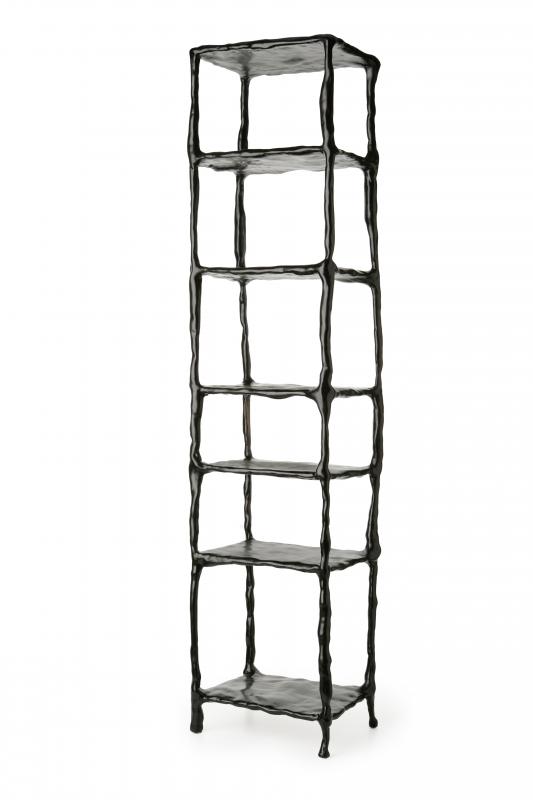
So get this. This free-standing set of shelves, from the Netherlands-based design firm Maartenbaas, is made of industrial clay, which is hand-modelled on top of metal skeletons, after which the entire surface is painted with colored lacquer. (Lest you think I actually know something about industrial design, I pretty much copied and pasted that from their website.)

It sort of looks like something you'd find in a Tim Burton film, or on a set for a live-action
Flintstones movie. Not my taste, and it seems more like display shelving than book shelving, but hey, at least people are trying.

Also from the Netherlands, but more to my taste, is this Variants shelving from Studio Roosegaarde.

Apparently, it was specially commissioned and designed for several public libraries, which is exactly ninety-seven shades of friggin' awesome. My local library, bless its heart, uses the kinds of battered formica tables that one sees in United Church basements, except unlike the church tables, the ones in our library are also adorned with signs warning patrons not to leave their property unattended because there are thieves actively working in the library. But I digress. (But seriously. Thieves! In libraries! I can now pinpoint the exact moment when I lost my last vestige of childlike innocence.)

The final part of this post is dedicated to Carrie, who I know, like me, has serious respect for Serious Shelves.

I'm not too proud to admit that I peed my pants a little bit when I first set eye on these OIKOS shelves. (This level of disclosure is what separates us serious bloggers from the also-rans.) If I had these bad boys in my home, I can't help believing that my world would be a better place. A better, bookier place -- where nobody steals your bookbag when you're not looking.

Wednesday, October 25, 2006

BOOKS: Orthagonally Challenged

I got this email from Meg recently:
Having read about your feelings on bookshelves and things that aren't orthagonal, this one should be of interest, if for no other reason than to drive yourself nuts with it.
Oh, Meg. How right you are.

Tuesday, October 24, 2006

BOOKS: A Spot of Awesome

All righty. I was just warming up with yesterday's batch of books. Today's bunch are, if you can believe it, even better. I lucked into a serious roll for a week or so. I probably should've been out buying lottery tickets instead of hunkered down reading books, but these things are always so easy to realize in hindsight.

A Spot of Bother
by Mark Haddon (#35)
I was excited and trepidatious about this book. I loved
The Curious Incident of the Dog in the Night-Time, and I worried that Haddon couldn't follow up his inaugural novel with another that would touch me in the same way. Fortunately, he doesn't even try. Instead, he starts with a fresh slate and a group of very different characters, each of whom gets to piece together the story in his or her own voice.

There aren't a lot of novelists who can write about a main character's real descent into insanity
in the context of a comic novel and still maintain their own, and their character's, humanity and integrity. But Haddon pulls it off with grace and hilarious ease, and if The Curious Incident didn't have you convinced that he's a genius, surely A Spot of Bother must. And if not, you're just a tough cookie and there's no reasoning with you.

I loved this book. It reminded me somewhat of
Douglas Coupland's novel All Families Are Psychotic, the book that I believe signalled Coupland's return to creating good fiction. So if you haven't read that yet, either, hop to it. Time's a-wastin'.

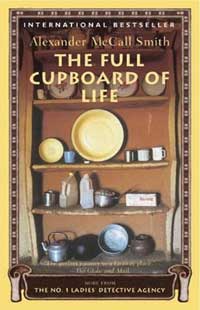
The Full Cupboard of Life
Alexander McCall Smith (#36)
Nothing much new to say here. If you haven't started reading McCall Smith's
No. 1 Ladies' Detective Agency series yet, I'm just going to assume you've been busy saving orphans and kittens from burning buildings and marauding pirates and rabid mongooses.

Or something like that. Good on you. I, on the other hand, who have now officially read every book in the series, am envious of you. The riches of these stories await you like so many ripe, succulent, late-harvest plums. Or something like that.


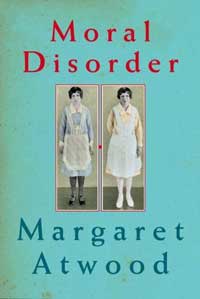
Moral Disorder
by Margaret Atwood (#37)
It's funny. It didn't even occur to me to think of this collection of vignettes, all centred around sixty years in the life of a family, as "disjointed" until I read this word in a review. I disagree. True, these stories lack the connect-the-dottedness of a traditional linear story, but to me that's what makes them work. All the spaces in this narrative made me think about all the silences, the weight of unspoken thoughts and feelings, that accumulate over the history of a family. The tension these gaps create in the story are not like the tension they create in a family -- because hey, it's a metaphor, not reality -- but they do their work just by reminding us that these silences exist, and that they have meaning in and of themselves.

What I loved about these stories was what a departure they were for Atwood from her previous work. They're intimate and tightly written, but this is Atwood we're talking about, so these stories are anything but insignificant. If you like Atwood, I think you'll really like
Moral Disorder. And if you don't normally care for Atwood, you should give this collection a try anyway. Trust me. I'm working for you here.

Woohoo! Six books down, and only two more to go. They said it couldn't be done, but here I am! In all my glory!

Monday, October 23, 2006

BOOKS: What's My Mantra?

If you want to check out the latest "Best of DNTO" podcast, go here. And I'm not just saying that because my segment on doocing appears in the last ten minutes or so. The whole darn show is pretty awesome, particularly the extended interview with Alexander McCall Smith, who is cultured and witty and has one of the most lovely speaking voices I've ever heard on a fellow human being.

Reviewing books! I knew there was something I was forgetting to do.

I'm a little behind on filing reports on the eight books I've read in the past month and a bit, and I'm probably not going to get through them all today, but I'm racing to get at least a few of them logged before I finish my ninth and tenth books (which I'm reading concurrently). Because being behind by eight books is a bit embarrassing, but being behind by ten? That's just plain discreditable.

Now, the bad news is that not only am I not good at following other people's good advice, I'm not even good at listening to myself when I quote the exact same advice. So my memories of some of these books are a bit spotty. But the good news is that I can remember enough to tell you if they're worth reading (in my always-humble-bordering-on-servile opinion). And the even better news is that many of them are worth reading.

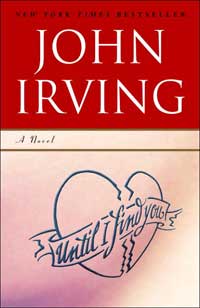
Until I Find You

by John Irving (#32)
This isn't Irving's best work (that title goes to either
The World According to Garp, The Hotel New Hampshire, or A Prayer for Owen Meany, depending on whom you ask), but it's not his worst, either. It's a somewhat messy, sprawling story, or more accurately two stories about the same set of events. Intrigued? Confused? I wish I could help you more, but I read this two months ago, so anything I could tell you would probably confuse you more.

If you've never read any of Irving's novels, I wouldn't start with this one. But if you
have read Irving's best novels (see above) and have a hankering for more, it wouldn't kill you to read Until I Find You. I liked it, anyway.

Stories from the Vinyl Cafe
by Stuart McLean (#33)
Speaking of CBC Radio (have I mentioned that you can download my recent appearance, in podcast form, here? Are you sure I already mentioned it?), I've always had a soft spot for some of CBC's venerable radio personalities.
Bill Richardson. The late Peter Gzowski. And now Stuart McLean.

DoppelSis
turned me on to McLean when she pressed this collection of short stories on me a couple of months ago, and now I'm regretting that I didn't grab the sequel from her when I had the chance. These stories have a sort of incisive poignance that occasionally reminds me of Alice Munro, but they also possess a self-deprecating charm that Munro lacks.

The Snapper
by Roddy Doyle (#34)
Another winner from
DoppelSis. I know that Paddy Clarke Ha Ha Ha is officially Doyle's great book, but between you and me, while I was technically dazzled by Paddy Clarke, it left me a bit cold emotionally. The Snapper, on the other hand, was warm and funny and clever as all get out. And yes, also charming. I'm a sucker for charm these days.

I was occasionally disturbed by the casual mentions of pregnant women getting shitfaced, but I kept chanting the mantra I use during these kinds of literary challenges: "Different context, different context, different context." It really helps. I may even start using this mantra in my real life.

All right, kiddies. It's late, and I'm tired. You're probably tired, too, so get to bed. I don't care if you're at work or school.

You heard me.

Friday, October 20, 2006

ETC: Definitely Not Shameless Self-Promotion

If you've been wondering what I've been up to in my spare time all week, listen to Definitely Not the Opera on CBC Radio One tomorrow, sometime between 2:00 and 3:00 pm.* I'll be talking with host Sook-Yin Lee about blogging, privacy, free speech, employment law, and how not to get dooced. You'll also hear from Cecily and Stacey, two of the many, many people who emailed me with their tales of blog-related skulduggery.

If you don't live in Canada and therefore can't enjoy the wonder that is our public broadcasting system, come back on Monday, when I'll be posting a link to the podcast.

*Actually, you should check out the entire broadcast, starting at 1:00 pm. Sook-Yin will be talking to one of my new favourite authors Alexander McCall Smith (!!!), and
Nick Purdon will be making the bold declaration that DBC Pierre's novel Vernon God Little could be the best book since Watership Down. Hmmm... now there's an argument I have to check out.

Thursday, October 19, 2006

BOOKS: 1001 Books You Must Read Before You Die

Have you seen this? Some brave, thick-skinned soul has compiled a list of the 1001 Books You Must Read Before You Die.

Despite the fact that, like you, I'm appropriately skeptical of such lists, I'm also way too compulsive not to calculate my own tally. (Either 190 or 200 out of 1001. I lost track at one point, and there's no way I was starting over.)

I'll also confess to a few exciting moments when I'd count off five or six books in a row, causing the chorus that constantly plays background music in my head to swell with the refrain "I AM THE SMARTEST WOMAN ALIVE." Though... not really, or else I'd have made the list myself. But I'll be frank and tell you I'm never going to read James Joyce's Ulysses, and I've made my peace with that. And since he seems to be a mainstay of these grand lists, my listmaking fate is settled.

What the 1001 Books list does well is gather together some excellent titles (others, not so excellent: er, Memoirs of a Geisha?) to pad out my already bulbous to-read list. And I like that the list takes a few risks by including populist writers such as P.G. Wodehouse, Ann Rice, and John Irving. And I love that Ayn Rand's entire oeuvre is securely housed elsewhere. There are many lists that I'm sure Ms. Rand belongs on. This isn't one of them.

Also, I really love that this list makes me feel a lot better about myself after my recent revelations about my ignorance of contemporary fiction.

What the list does much less well is provide broad international representation. It was great to see Patrick White's Voss, but where is Keri Hulme's The Bone People? And of course Margaret Atwood belongs on the list, but yoohoo? Whither Alice Munro?

Dang. I'd forgotten how much I love picking apart a list. I've got to go back for another look.

(Link via the always-erudite Karen at Verbatim)

Wednesday, October 18, 2006

ETC: Good Point

Scene: A typical North American living room. On the television, the movie X-MEN: The Last Stand plays.
"So this is an American movie starring an Australian actor who plays a Canadian superhero?"
"Would you cast a Canadian as a superhero?"
"We're wimps."
"Australians are like us, but more rugged."
"They're action Canadians."

Tuesday, October 17, 2006

BOOKS: Meee-OW!

So, as many of you know, the finalists for the Governor General's Award for Fiction were announced yesterday. And of course the Giller Prize finalists were announced at the beginning of the month. And now let the prize committee catfights begin!
The Governor General's Award for literature's fiction award has had to compete with the glitzier Giller Prize since the latter award was created in 1994. But the two shortlists were decidedly different, with only [Montreal writer Rawi Hage's debut novel] De Niro's Game making both lists.
Fair enough. Different strokes for different folks, right? Oho, but what have we here?
"I have a strong suspicion the Giller Prize did not look at three of the books that made our shortlist because otherwise I don't see how they could have passed them over," said [author and Governor General's Award juror Leon] Rooke...
Meee-OW.

If you're not able to follow any of this, I don't blame you. Neither can I, what with not having read ANY of the novels on either shortlist and all. But that's okay. If you're in Vancouver, you can get up to speed quickly, because the International Writers & Readers Festival starts today, and a few of the shortlisted authors from both lists are in attendance, including Gaétan Soucy, Rawi Hage, and Bill Gaston.

If you want to shake things up a bit, I'd also recommend checking out David Sedaris, Anita Rau Badami, and Lisa Moore, as well as spoken word poet Shane Koyczan (and I'm not a person who recommends spoken word lightly). No word yet on whether Jackie Collins will be in attendance, but I think they're hashing out the final details of her rider. Apparently her chihuahua hates blue M&Ms.

Monday, October 16, 2006

BOOKS: My Ignorance Knows No Bounds

The finalists for the Governor General's Award for Fiction have just been announced. And once again, I'm floored by my ignorance in matters literary. Apparently, this list is dominated by first timers, but still.

Note to self: Pull head out of butt.

(But at least I know whether or not to hyphenate "Governor General," unlike a certain national newspaper that shall remain unnamed.)

Friday, October 13, 2006

ETC: Have You Been Dooced?

Fellow internet citizens! I have a request.

I'm working on a pitch for a segment for the esteemed Canadian radio show Definitely Not the Opera. The segment is all about getting "dooced" and all the various ways your blog can bite you on the ass. I want to interview a few people (and use sound clips of the interview) about how their online confessional tendencies have caused them strife... or at the very least social awkwardness.

Overall, the tone of the piece will be funny (that's the hope, anyway; work with me, people!), but I'm also going to slide some interesting stats in there, as well as some tips on how NOT to get nailed.


If you're interested, or if you have questions, please email me at 50books[AT]gmail[DOT]com. And thanks! You guys rock. You may even rawk, but you're going to have to prove it to me.

Wednesday, October 11, 2006

BOOKS: Portrait of an Increasingly Unhinged yet Highly Caffeinated Blogger

I'm pretty tired today. I mean, I'm always tired, but today I'm a bit more so than average. But I'm nowhere as tired as I was several days ago. In fact, last week marked an exciting new parenting milestone for me. I hit a previously uncharted level of exhaustion, rendering me THE MOST TIRED I HAVE EVER BEEN IN MY WHOLE LIFE.

If you've never parented a child with erratic sleep patterns for months and months and months, then I hate to sound all exclusionary, but you don't know from tired. I'm not talking "tired from pulling an all-nighter to write an essay" or "tired from a three-day long-weekend bender" or "tired from having awesome beginning-of-relationship sex for days on end." I've been all those kinds of tired, and they don't even come close to comparing with the limp, demoralized, soul-deep fatigue that comes from being denied a healthy amount of sleep night after night for more than a year, interrupted every few weeks by bouts of almost total sleep deprivation that make you realize you have absolutely no reserves remaining in your sleep tank. Last week, my needle was buried waaaaay to the left of "E."

What would I do without coffee? I've written about my recent love affair with the magical beans, but it wasn't until yesterday that I realized that my passion has escalated to nigh religiosity. I worship coffee with the kind of athletic reverence that used to see monks flagellating themselves with whips or the faithful making lengthy pilgrimages on their knees. If required to do these things to get my daily brew, I'd seriously consider it. Dignity? Dignity is for chumps.

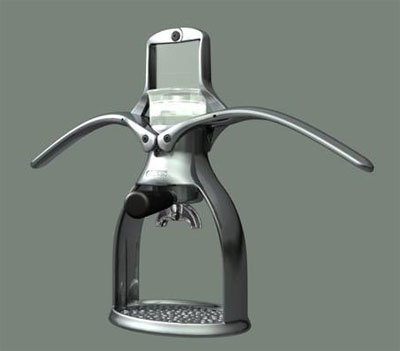
Sometimes I almost believe in Providence, though. Because mere days before the advent of Sam's latest bout of nocturnal shenanigans, my closest friend, The Glorious Nomadic Suzi Bicyclefish -- a woman who clearly peers through some kind of mystical window into my future -- brought me this fabulous gizmo all the way from the motherland:

You're perplexed, I can tell. What if I told you that you are looking at the most beautiful gadget ever devised to take simple coffee grounds and alchemically transform them into deep, rich, perfect espresso? It's called a Presso, and not only is it pleasing to the eye and to the touch, it's also so simple to use that even I can't fuck it up -- not even on three hours of sleep while a toddler tries to pull down my pyjama bottoms.

And it doesn't even use electricity! Anyone who thinks England's glory days as a world power are behind it has another think coming. The British are a superior people and they deserve our unmitigated admiration and respect.

In celebration of love, life, and humankind's intrepid spirit of inventiveness, I was GOING to make a list of my favourite books and passages that, in their own small yet potent ways, demonstrate their kinship with me in their love of all things caffeinated. But then I couldn't find any.

I know that these passages exist, yes, indeed. I can recall specifically a gorgeous description by Hemingway of a café au lait he enjoyed in Paris in the '20s... or perhaps it was one of the characters in Garden of Eden? I don't rightly recollect. And I remember Kerouac wrote something delicious in Dharma Bums about coffee prepared à la hobo, simply with hot water and grounds in a frying pan or an old bean tin or something like that. But can I find these passages? No, I cannot.

I did manage to find this little bit from Steinbeck's Travels with Charley, one of my favourite books:
I poured him a cup of coffee. It seems to me that coffee smells even better when the frost is in. "A little something on the side?" I asked. "Something to give it authority?"
"No--this is fine. This is nice."
"Not a touch of applejack? I'm tired from driving. I'd like a spot myself."
He looked at me with the contained amusement that is considered taciturnity by non-Yankees. "Would you have one if I didn't?"
"No, I guess not."
"I wouldn't rob you then--just a spoonful."
So I poured each of us a good dollop of twenty-one-year-old applejack and slipped in on my side of the table. Charley moved over to make room and put his chin down on my feet.
That's the best my addled memory can serve up. So instead I turn to you, o wise friends of the internet, to help rustle up some memories. What are your favourite coffee-related literary passages? (How's that for an overly specific request? I'm just trying to keep you on your toes.)

Monday, October 09, 2006

BOOKS: Irony's Revenge

Yesterday was Canadian Thanksgiving, and I've only just managed to claw my way out of a tryptophan coma. Seriously, someone ought to put that shit in pill or juice form. Holy cow.

In case you're wondering, here in Canada we like to give thanks for the same things as everyone else: family, friends, food, freedom, and... er... more food. And speaking of being thankful, I'd also like to give thanks to
Kat for sending me this link after I posted recently about the parents (who hadn't read the book, of course) who are trying to have Ray Bradbury's Fahrenheit 451 pulled from the curriculum and libraries of all the schools in their district.

Here's the best part:
The school has appointed a committee to review Verm's objections. But students are now circulating a petition in support of the book. They plan to wear t-shirts on Friday voicing their opinions.
Ha!
"This was probably one of the greatest eye openers that we've had in our school curriculum," said student rally organizer Darrell Lee. "A lot of the people who did sign said that of all the books they had to read, this was the one they enjoyed. It really makes you think about the situation."
Okay. Now here's where I have to confess that, while I've been meaning to for years, I've never gotten around to reading Fahrenheit 451. But all this kerfuffle has got me hankering to get my mitts on a copy and hustle it to the top of my to-be-read pile. So I went to Amazon to see what kinds of editions are available.

And wouldn't you know it? The mass market paperback of Fahrenheit 451's sales have shot up in the past week. Last time I checked, it was ranked at #338.

HA! HA!

When are the book banners going to learn that we book lovers are contrarians by nature? Hopefully the answer is "never," so that we can continue to enjoy a few laughs at their expense.

Friday, October 06, 2006

WORDS: A Rose by Any Other Name Might Be a Jerk

Before Sam was born, when people would ask us if we'd picked out names already, we'd unhesitatingly tell them, "Yes!" And then we'd proceed to tell them the names. Clearly, we were naive first timers, because I've since learned that conventional wisdom dictates you don't tell anybody, so as to avoid unsolicited opinions from the peanut gallery.

But we were pretty confident with our choices, and the name "Sam" generally met with a positive reception. (And if anyone ever did say anything negative, I've completely forgotten about it. This is why it's okay to be a jerk around me. I rarely remember bad manners.)

"Sam," people would repeat after us, with a little smile in their voices. "That's a good name."

"Thanks," we'd reply modestly. "We know."

At the time, we thought we were totally bucking convention. "Nobody's using the name 'Sam'," we'd cackle gleefully to each other. "This is awesome!" And then Sam was born, and since then I've met FOUR other babies and toddlers named Sam in my 'hood. Oh, well. I don't mind, and it's nice to know that there are so many other people out there with excellent taste.

A few months ago, I was talking to my fellow Bored Housewife Anne-Marie, who also has a little boy named Sam, about why we picked the name. "I don't know," said Anne-Marie. "It just sounded friendly. 'You can always count on Sam. Sam's got your back.'" I agreed.

It turns out we weren't just blowing smoke up each other's butts. According to the Baby Name Wizard, Sam ranks high on a "likeability" poll they conducted. (The poll was spawned by this earlier post.) Other names perceived as friendlier than average include Charlie, Tom, and Jack for boys, and Molly, Sarah, and Katie for girls.

As interesting as these informal statistics are, what's more interesting to me are the comments at the bottom of the post. Some people said that while these names are friendly and all, this fact may explain why they've been commandeered by pet owners, rendering the names unattractive for use on human beings. (My good friend Charlie will attest that he can't walk past a dog park without hearing his name called out, usually followed by the phrases "Get the ball!" or "Don't eat that!")

Other people mention that these so-called friendly names are pretty white. I'm no expert on the subject, so I'm not in a position to comment. Though Samuel L. Jackson or Sammy Davis Jr. (bless his soul) may wish to chime in.

Still other folks agree that "it seems very superficial to choose a name for that reason - because it's 'likeable'." And it's this sentiment that I tend to disagree with. Since when did being likeable become a bad thing? And sorry -- superficial? What?

When I think about it, the qualities that make a person likeable are not trivial or commonplace. When I imagine a truly likeable person, I imagine someone who is intelligent, sensible, honest, loyal, and fun. How many people do you know who fit this description?

I believe that we grow into our names and faces. By the time a person is 35 or 40 years old, their character can be read on their face as surely as words on a page. And I believe that we spend our lives wrestling with the names we are given, either trying to buck against the ideas we imagine our names embody, or trying to emulate them. And it goes from there that I believe that giving someone a name should give them something to aspire to.

In these crazy, dog-eat-dog, increasingly libertarian times in which we live, I think likeability -- true likeability -- is going to become an increasingly rare quality. Intelligence, common sense, honesty, loyalty, and a sense of fun -- these seem like pretty worthy goals to me.

But what do I know? I'm named after a popular country-Western singer. I've clearly got an axe to grind. I'm interested to hear what other people think -- of their own names, and the topic of names in general.

(Ups to Shona for the linkage!)

Tuesday, October 03, 2006

BOOKS: Dear Sweet Fucking Merciful Crap

So, Rusty just forwarded me this article.
"It's just all kinds of filth," said Alton Verm, adding that he had not read Fahrenheit 451. "The words don't need to be brought out in class. I want to get the book taken out of the class."
Is it just me, or has everyone forgotten to take their irony pills lately?
Alton Verm's request to ban Fahrenheit 451 came during the 25th annual Banned Books Week. He and Hines said the request to ban Fahrenheit 451, a book about book burning, during Banned Books Weeks is a coincidence.
Irony pills? What are irony pills?

But don't fear. This matter is in the capable hands of the Conroe Independent School District. This is the same district that banned Draw Me a Star three years ago, a book written by award-winning children's book writer -- and noted Satanist -- Eric Carle, the same guy who also brought us such subversive texts as The Very Hungry Caterpillar and The Grouchy Ladybug.

Won't someone think of the children?

Monday, October 02, 2006

BOOKS: Judging Books by Their Covers, Part Two

I just received a very commanding email from DoppelSis ordering me to update my site. Because I'm a little bit afraid of her (as should you be, if you have any sense), here I am EVEN THOUGH MY HOUSE IS CRUMBLING AROUND ME AND I'M VERY, VERY BUSY. (Sorry. That guilt trip was directed at DS, not at you.)

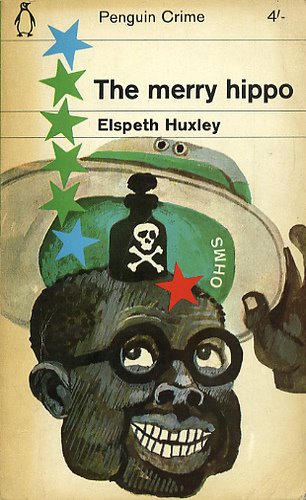
Rusty sent me this link to a rather nifty photoset on Flickr. Somebody's taken the time to collect some very, very cool cover art from old Penguin novels. Devotee that I am to Penguin's classic orange covers, I have to admit that these are pretty awesome -- quirky, evocative, and sometimes downright weird.


When I compare these covers to the cover art for some contemporary novels that I reviewed a while back, I have to wonder why book design has gotten so boring. Can anyone fill me in?