I don't like to slag books, even books I didn't care for (except for you, Nanny Diaries; consider yourself officially on notice). It just seems like a dick thing to do. I mean, if someone else got something useful or beautiful out of a book -- or even if it just managed to distract them from their worldly cares for a few hours -- who am I to pee all over that?
I just realized that this is why it's taken me so long to write about the books I've read in the past month: I'm blocked because I don't want to sound like a dink about a particular book that, if sales are anything to reckon with, a lot of people really enjoyed. But a book blogger's gotta do what a book blogger's gotta do, so here goes.
The Five People You Meet in Heaven
 by Mitch Albom (#31)
It took me a while to figure out why this book wasn't sitting well with me. At first I thought that maybe it was the overt sentimentality of the writing, but then I reminded myself that I like Little Women and pretty much every kids' story about animals ever written, so I can stomach more than my share of literary treacle.
If you don't know the story, it's about an old man who dies in a tragic carnival accident (shush, you smartasses in the back row). As he travels through the afterlife, he meets five different people who had some impact on his life at different points in time, and through each of these encounters, he has an epiphany that helps him move forward. I won't tell you how it ends, but I'm sure you can figure it out.
In other words, it's your classic "this was your life" scenario, with the typical ensuing self-knowledge and redemption and sense that one's life was worthwhile and that even the bad things make sense in the grand scheme of things. And whatnot. Included in the "whatnot" is the reminder that all our lives are interconnected. There may also have been mention of a certain butterfly flapping its wings in the Amazon, though that might have just been implied.
If you sincerely got something out of this story, then bless you. Seriously. And I apologize if my thoughts offend you. But really, who the hell am I? Just some chick with some random opinions, which have no more value than your own. Remind yourself of that as you read the rest of this post.
Okay. So. What bugs me about this book is that I got to the end of it and was, like, "Well, duh. Am I to take it, Mr. Albom, that you are letting me know that self-acceptance is important? And forgiveness? Also important? And that everything happens for a reason? And that, while loss sucks, a person who finds love even once in their life is lucky? Really? You don't say."
And... okay. Let's take it as a given that, if you really think about it, pretty much ALL novels cover some variation on these themes. I'm fine with that. But most other novels -- well, the good ones, anyway -- tend to expound on these ideas in a way that is varied and complex and richly textured. They don't cover each theme in its own separate CHAPTER, so that we the readers can go down a mental checklist as we make our way through the book. Self-acceptance? Check. Tolerance? Check. Etcetera etcetera.
I also profoundly disagree with the notion that everything happens for a reason. To me, this has always seemed like a safe, facile tool to help us stomach the fact that terrible, mostrous, unspeakable things happen in this world. I sympathize with the need to rationalize bad things -- hey, I like to sleep at night as well as the next person -- but it's a dangerous way to think, and possibly a sign that truly horrible things have never happened to you.
The Five People You Meet in Heaven feels, to me, like a weird, uneasy hybrid of The Pilgrim's Progress and The Wealthy Barber... a sort of "Spiritual Awakening for Dummies." But I don't think Albom is a dummy. And I don't think that the millions of people who read this book are dummies (other than the statistically probable few). I just think that if you're looking for a novel to uplift and inspire you, you owe it to yourself to do better. We're all smarter than this.
We've had a touch of bad luck lately at Casa Doppelganger, but does that keep us down? Ha! It does not!
Despite the fact that ceilings are waiting to collapse on our innocent sleeping heads and burglars are lurking in our shrubbery seeking any opportunity to steal our electric can-openers and express their creativity -- in poop form! -- on our stoop, Sam and I bravely soldiered out on Sunday to enjoy Vancouver's umpteenth annual Word on the Street festival. And we had a mighty fine time.
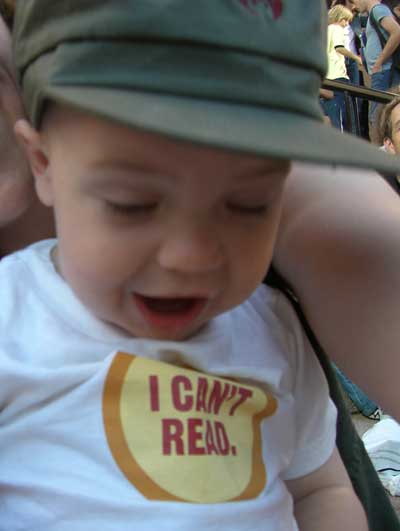
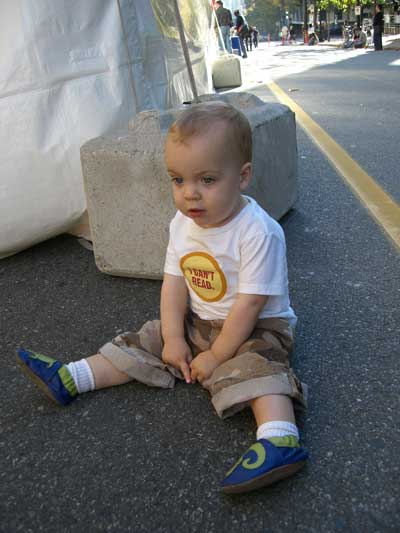
Though, come to think of it, Sam's highlights were the Knowledge Network booth, where they were pimping that adventurous little harlot Dora the Explorer (or as Rusty prefers to call her, Dorer the Explorer) and the honest-to-god city bus that had been parked in Library Square for the kids to explore... neither of which is terribly literary, when you come to think about it.
But can you blame him? The poor guy can't even read!

 Won't someone think of his shame?
The world is too much with us; late and soon,
Getting and spending, we lay waste our powers;
Little we see in Nature that is ours;
We have given our hearts away, a sordid boon!
This Sea that bares her bosom to the moon;
The winds that will be howling at all hours,
And are up-gathered now like sleeping flowers,
For this, for everything, we are out of tune;
It moves us not. -- Great God! I'd rather be
A pagan suckled in a creed outworn;
So might I, standing on this pleasant lea,
Have glimpses that would make me less forlorn;
Have sight of Proteus rising from the sea;
Or hear old Triton blow his wreathèd horn.
Hey, what do you know? Sometimes poetry does make you feel better.
So.
Clearly, I misspoke in my most recent post. When I railed against the bad people who make and/or fix our consumer products badly, what I REALLY should have been complaining about were the bad people who break into our homes and steal our badly made consumer products. Because yesterday, for the second time in three weeks, our house was broken into in broad daylight.
Was I courting this bizarre coincidence when I made these comments a while back? Perhaps. But I maintain: it's not the loss of minor electronic gadgets that bothers me. What I find I'm (predictably) bothered by is the textbook case of the squicks I've developed surrounding the fact that strangers have seen their way to enter my home violently and walk around as if they have every right to be there.
That, and the giant crap one of them took on my porch. That seemed excessive to me.
And how is this post about books? Well, at least they rarely get stolen. Books: priceless to us, worthless to some poor slob in need of a fix.
Nothing makes you feel really adrenaline-pumpingly alive like being awoken at 2:30 am by the sound of the ceiling in your child's room spontaneously loosing itself from its moorings and crashing to the floor.
Once we'd extracted our hearts from our throats and restored them to their proper location, Rusty verified that, in fact, only a two-foot-by-three-foot chunk of ceiling had come down, and mercifully, it had chosen to come down from a space that is NOT located over Sam's crib. Still, it made a hell of a mess, in addition to scaring the living bejeebus out of us, so we woke Sam up (yes, he slept through it; that's my boy) and brought him into our bed for the rest of the night. And we were promptly reminded of why we made the decision to kick him out into his own bed eight months ago.
Sam is a bad bed citizen. Oh, he was fine for the first little while. But then the writhing started. And the pillow hogging. And the lying sideways. And then he wanted to nurse, and I figured, hey, his ceiling almost fell on him, he deserves a late-night treat. But then he wanted to keep nursing. Like, for hours. And when I cut him off, rather than pitch a mini-fit -- something he would have done up until last week -- the devious little bugger started signing "more" and repeating "Mowah? Mowah?" in a way that would have been charming and irresistable if it hadn't been 5:30 in the morning. Despite being denied, he was still pretty chipper, which I guess is commendable... if said chipperness didn't manifest itself in babbling adorably whilst trying to stick his fingers in my nose.
Hmm. This story seems to be taking a long time to tell. I'll try to speed things up. I'm not making any promises, though.
So then this morning I went to the site of my closest friend Suzi the Nomad, aka Bicycle Fish aka The Fabulous Suzi, where I learned that her flight from London to Vancouver had to be turned back because the plane was spewing FUEL all over the friendly skies. And between Suzi's plane and Sam's ceiling, I have to wonder: what ever happened to proud workmanship? Because I feel like someone's been sleeping on the job these days, and I think it's catching.
To wit:
- Our four-month-old, two-thousand-dollar Stearns & Foster Mattress -- the Cadillac of mattresses, we were told, commissioned by the fancypants Plaza Hotel in New York City, host to high-maintenance sleepers aplenty -- is defective. We have this on official word from the mattress technician who was sent to our house to investigate our claim. It has developed squeaks and sproings and generally just doesn't sound right.
- Both Rusty's PowerBook and my iBook contain those controversial batteries that overheat and cause fires. For this reason, I'm tempted to start using a photo of a young Drew Barrymore as my desktop wallpaper, but I'm worried that kind of smartassery is just tempting fate.
- Our Natuzzi armchair, which was only one year old at the time, had to be sent back to the manufacturer for repair, because there was a structural defect in the frame which resulted in one arm actually collapsing in upon itself.
Stearns & Foster! Apple! Natuzzi! I'm not a label whore by any stretch, but these are all good brands that should produce quality merchandise, right? However, as our housemate The Don -- who is reasonable, pragmatic, and understands how things like electricity and plumbing work -- explained to me, when you buy from a reputable company, you're not necessarily buying a better product: you're buying a better warranty. And he's right, I guess, because all these items have been, or are being, replaced by the companies without any undue kerfuffle.
But still. Where's the workmanship? Where's the pride? Where's the love? Back in my day, people stood behind their work. If you took your horse to Tom the blacksmith for new shoes, those shoes stayed on, dadgummit. And if they didn't, well, not not only did Tom fix 'em up, lickety-split, he had the decency to look shamefaced.
You know who rarely lets you down? Books, that's who. I can count on one hand the number of new books I've owned that have exhibited structural weaknesses, that have buckled and folded under the stress of a commuter's backpack or given up the ghost after being spreadeagled callously on a damp beach blanket all day. You pretty much have to drop a book in the tub to kill it, and even some of those come back to life. You can count on books.
So you can imagine how thrilled I was when flipping through the newest issue of Dwell to discover an article about Irma Boom, who is widely considered one of the most important book designers working today. She may also be my new hero. (In one interview, when Boom is asked about her tendency to eschew client briefs, she replies, "That’s right. Most briefs sound so uninteresting that I get paralysed." I love her.)
Irma knows how to make a book, I'll tell you.
Boom doesn't design the kinds of trade books you see in most bookstores. Instead, she works in a more rarefied arena of projects for institutional clients (i.e. the kinds of people who want to create archival-quality texts that are beautiful and that will last, and who aren't afraid of the price tag attached to these requirements).
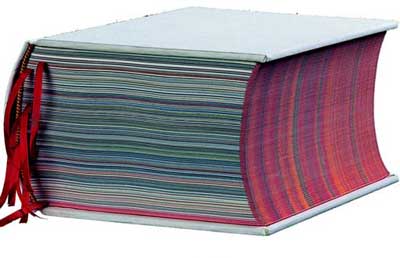
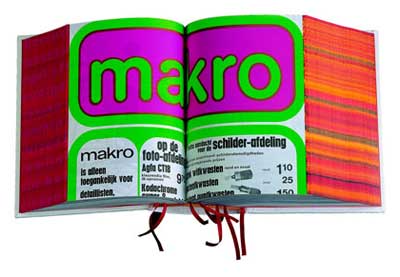
Of the many books Boom has helped produce, the one that I find most fascinating -- conceptually, at any rate -- is the corporate history of a huge Dutch conglomerate called SHV. Here's the finished work:
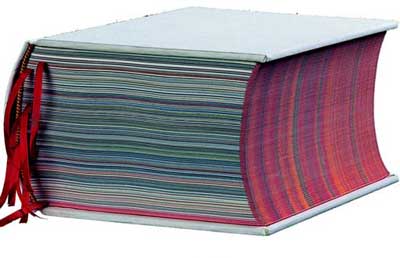
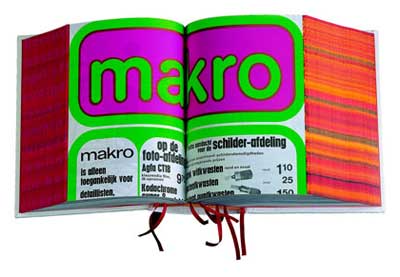 And here is Boom's description of the book:
If you look at the SHV book, you'll see that it's completely non-linear -- you navigate it more like a website than a traditional book. Although there are 2,136 pages, there are no page numbers and no index. It's non-chronological, because I wanted it to work as the memory does -- the more recent stuff is all at the front, and it's more complex, more detailed; then, as you get further away in time, it's more filtered, with a simple, quiet design. Ironically, we had considered making a CD-ROM first, but had we done so, the technology would already be obsolete. A book has this great physical advantage of being timeless.
Non-linear, non-chronological, and no page numbers. How many of you just had OCD-related seizures? Still, you've got to admit it sounds interesting.
And how many of you read the first half of this post and figured it couldn't possibly come round to books? How many times do I have to tell you: it always comes round to books, baby.
Thanks so much to everyone who was kind enough to write me with your generous words about my segment on CBC Radio One's Definitely Not the Opera. And thanks especially to Tara for hooking me up with DNTO's awesome executive producer, Iris.
This just in! DNTO's podcast of the entire show can be found here. My segment starts at roughly the twenty-two-minute mark. I heart Rgscarter for posting the link, despite the fact that listening to my own voice makes me cringe. You may feel differently. Or not! But if not, don't tell me about it, okay? I'm fragile.
***
Every year at this time, the shortlist for the Man Booker Prize for fiction comes out, and I find myself floored by my literary ignorance. This year, of the six books on the shortlist, not only have I read none of them, I only recognize… well, one. And I’m not alone. When I talk to other book lovers – people like you and me – we’re all in the same boat. So how are we supposed to jump into all the heated Booker debate?
Well, they say you’re not supposed to judge a book by its cover. Pffft. If you aren’t supposed to judge books by their covers, why do publishers work so hard to design covers solely for that purpose? Otherwise, all book covers would have nothing but plain black lettering on a white background. Which, come to think of it, would be pretty cool in a “In Soviet Russia, book reads YOU” kind of way.
But here in the glamorous western world, we have books with all kinds of fancy covers, and that’s what we’re going to use to review this year’s Booker finalists – and pick the winner!
What you’re about to read is for entertainment purposes only. The writer intends no disrespect toward the writers and their books, nor toward their publishers, the literary community, or the written word at large.
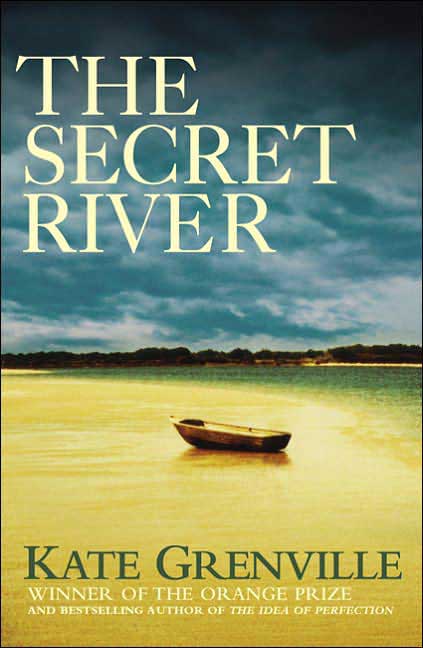
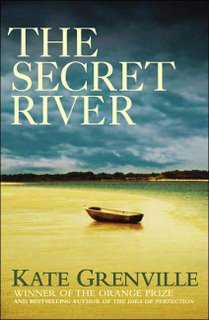 The Secret River
by Kate Grenville
In case you didn’t catch that title, the cover art drives the point home by showing you… a river… a river with an empty boat resting on its shores. So we’ve got secret rivers and empty boats. And is that a grey, lowering sky we see overhead? I’m thinking that what we’ve got here is a story about someone… who’s on a journey… looking for… something. I’d say that in this finely written, carefully nuanced story of love, loss, and redemption, the protagonist searches in vain, but learns something about him- or herself in the process. Everyone loves this kind of tale, yet I don’t see it as the winner. That cover art is just a bit too literal.
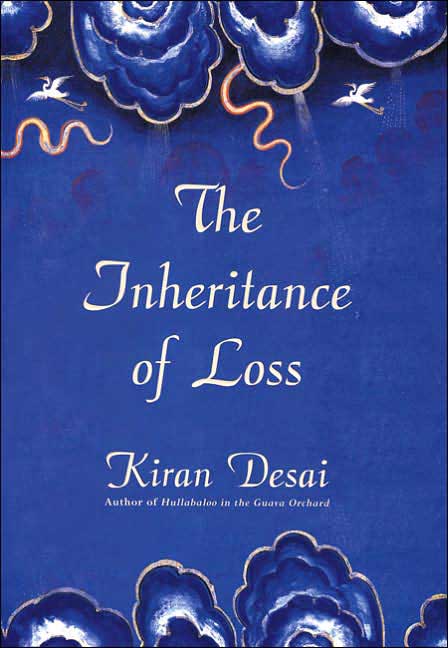
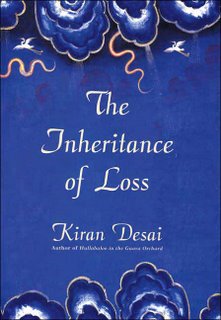 The Inheritance of Loss
by Kiran Desai
I like this cover. It’s a nice shade of blue, with a muted, stylized pattern of clouds on it, and some prettily rendered illustrations of what I take to be cranes – the birds, not the construction machinery – ascending heavenward. It’s got a sort of old-world-meets-new-world Indian quality. That, coupled with the title, gets me thinking “sweeping multi-generational cross-continent family saga.” But to me, that sounds a bit safe for the Booker folks, who in recent years, have preferred to give out the prize to more experimental storytellers, such as Margaret Atwood and Yann Martel. And also – I hate to say it – blue just says “runner-up” to me.
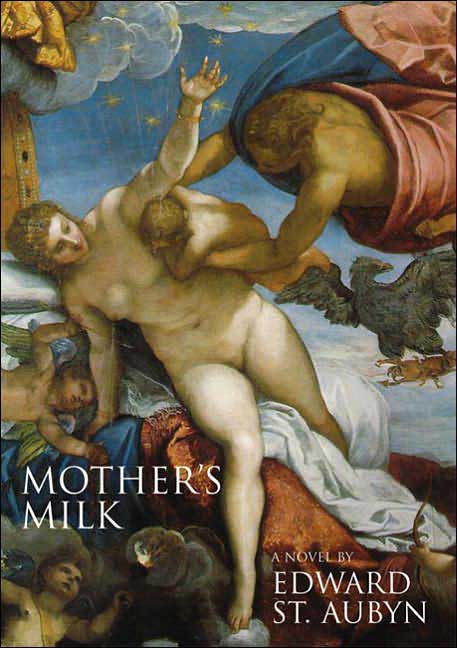
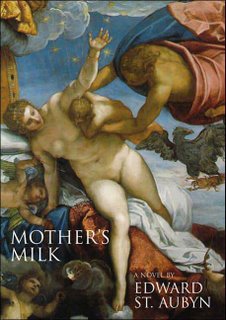 Mother's Milk
by Edward St. Aubyn
This book has “also-ran” written all over it. The cover is a detail from what I presume is a classical painting in the style of Michelangelo. Angels and otherworldly creatures abound, but the focal point of the piece is a robed figure holding an infant out to suckle at the breast of a naked woman. Yawn. Sorry. It just looks a lot like the cover of my first-year Classics textbook.
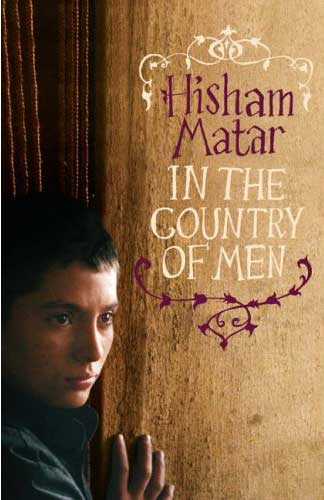
 In the Country of Men
by Hisham Matar
Now here’s where I have to confess that in the past few years, the publishing industry has conditioned me to believe that any time I see a photograph of a besmudged Middle Eastern child on the cover of a book, especially if said child is looking very serious, the story is going to be a wartime tale. I could be wrong about that, but you can bet your bottom dollar that this book is not light comic fare.
And yet! That font the publisher has chosen for the title… as well as that nifty little scroll design… both are so airy… so whimsical. I am baffled. Now, the question is, will the Booker judges by put off by this minor bit of cognitive dissonance? I think they might. No one minds being wrong about their assumptions of a book, but everyone minds not being able to get an initial bead on the book. Better luck next year.
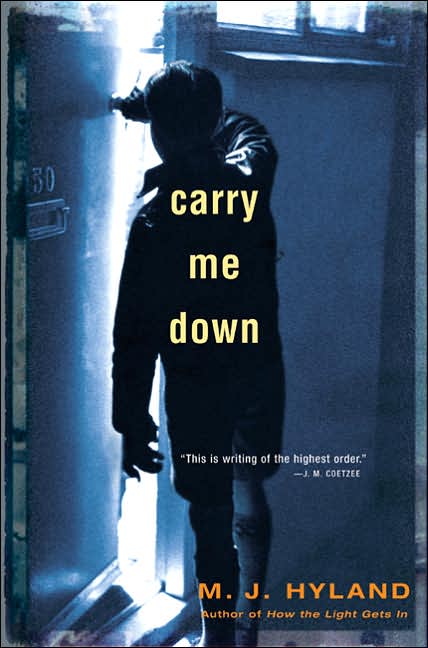
 Carry Me Down
by M.J. Hyland
This one is a bit of a cheat. The publisher has sneakily placed a blurb by two-time Booker winner J.M. Coetzee on the cover, stating that “This is writing of the highest order.” The publisher also makes a point of reminding us sternly that Coetzee himself is not just a past Booker winner, but also a Nobel Laureate. Who are we, the humble reading public, to contradict the authority of a publisher’s blurb?
But let’s move on to the cover photograph. We see a young boy from behind, as he peeps out of a doorway. He’s in a somewhat dingy room, so we can guess that he comes from working-class roots, something the prize giver-outers always love. He’s wearing short pants and thick knee socks, which indicate this is a period story of some sort, also a crowd pleaser. The room he’s in is dark, but we see light coming through the slightly open door. He’s peeping out from darkness to light, so we can guess that he’s seeing something wonderful or awful. Either way, it’s something that has changed or will change his life forever. And it goes without saying that this is no ordinary boy. They never are.
I’m thinking this story could be a winner, but for the fact that it’s vying with this next title, this year’s Booker winner.
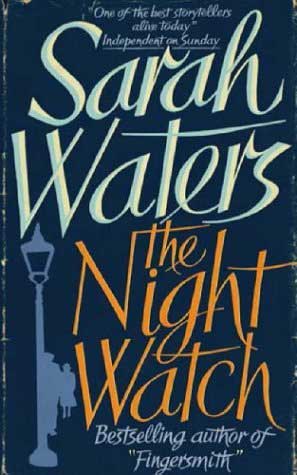
 The Night Watch
by Sarah Waters
Sarah Waters… Sarah Waters… Sarah Waters. Can I have a word with your publishers, please? I’d like to ask them why they persist in making your books look like the cheesy novels that they so brilliantly riff on. Your most recent book, The Night Watch, looks like a cheap dime-store thriller. A lamp post? A LAMP POST? And yet you write so beautifully, you’re such a captivating storyteller, and you do such a subtle, clever, haunting job of reinventing other genres. Not only am I sure that The Night Watch is an incredible story, I’m equally sure that the Booker committee will forgive this aesthetic lapse as readily as I do. Congratulations.
***
So there you have it: a rigorous analysis of this year’s Booker contenders. The winner: The Night Watch by Sarah Waters in the final heat. The Booker committee will make its official announcement on Tuesday, October 10th. Tune in then, if you must.
There's a short story by A.S. Byatt that still makes my blood chill in my veins when I think about it.
A wealthy middle-aged woman is on business trip to a major Asian city with her CEO husband, along with a contingent of his colleagues and their wives. While the men are sequestered in conferences and meetings, the wives are squired around the city by tour guides. While many of the women have buddied up for the tours, the main character is shy and something of a loner. At one point, the tour bus full of women is taken to a huge shopping mall. The woman gets separated from the group, and no one seems to notice. Confused and lost, she tries to enlist people's help, but no one speaks English. She either loses her purse or it is stolen, she's not sure. Increasingly disoriented and bedraggled as the hours pass, she is eventually taken for a beggar woman. When she finally encounters a policeman or some such authority figure, who speaks some English, she is so flustered that he assumes she is a crazy woman.
At the end of the story, the woman is left, alone, muttering, wandering the mall. What eventually happens to her is a dark mystery that I don't like to think about any more often than I have to.
Fiction is a sweet-tongued mistress who will slit your throat with the sharpest turn of phrase, the most devastating knife twist of plot. This is why fiction must always be approached cautiously: you never know when she's going to jump out at you with a dagger in her teeth. And this is why when the going gets tough, the tough read kiddie lit.
Stuart Little
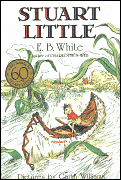 by E.B. White (#28)
The Great Gynecological Debate surrounding Stuart Little had pretty much the effect you'd expect: I found myself needing to read this book for the first time in -- good lord -- twenty-five years. And you know what? I liked it much more this time around. In fact, I think I like it more than Charlotte's Web.
Sure, Charlotte's Web is a tighter story, with a neatly resolved ending. And yeah, it still makes me cry. But there's something so clever, so grown-up, about Stuart Little, including the fact that it ends inconclusively, with Stuart driving off into the sunset in search of his friend. Just like real life!
And yes. He definitely is a mouse-child born of a human vagina. Beyond a doubt.
Return to Gone-Away
 by Elizabeth Enright (#29)
This is a sequel to Enright's earlier, and perhaps better-known, story, Gone-Away Lake, about three children who discover a long-forgotten lake populated by a half-dozen or so empty mansions. These houses served as summer homes to wealthy families decades earlier, before the lake dried up and people's fortunes changed. The houses have been abandoned by all of their owners except for two, an elderly brother and sister who fell on hard times and returned to their childhood homes.
While Gone-Away Lake contains plenty of adventures of the sort that fans of Enright's writing have come to expect, I've found that I prefer the sequel. In it, the children's parents buy one of the houses to use as their own summer home. There are a few adventures, but essentially this book is a series of anecdotes about home renovations. As a kid, I'm not sure how I would've felt about the chapter where they discover a bunch of valuable early-American antiques in the attic, but I know that as an adult, I almost squealed with glee. I also found myself far too overly invested in the mother's choice of paint colour for the living room.
The Long Secret
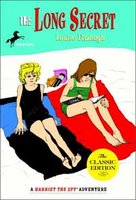 by Louise Fitzhugh (#30)
I've lost count of the number of times I've declared my huge love of Harriet the Spy, so I won't go into that again. What's surprising, then, is that for all these years I've managed to not read Fitzhugh's sort-of sequel to Harriet.
The Long Secret takes place during the summer vacation after the school year documented in Harriet. Interestingly, we learn that Harriet and Beth Ellen (the pretty, pathologically shy girl in Harriet's class) are always best friends during the summers that their families spend in Montauk. The story, presented mostly from Beth Ellen's point of view, is remarkably sensitively told. We get a portrait of a young girl struggling with issues of family and self-esteem and faith, but the story never degenerates to the level of an after-school special. Honestly, you have to read it yourself to get what I'm talking about, but as an adult, I have to sort of admit that I think I prefer The Long Secret to Harriet the Spy. Don't hate on me, Harriet lovers! My world has gone topsy-turvy!
It's funny that as a kid, I had all these favourite novels, but I rarely took the time to seek out other books by these writers, instead relying on happenstance to let them fall in my hands. I think I need to dig through my childhood favourites and do some searching for new reading material.
So what were your favourite books as a kid? And have you found, like me, that your tastes have changed as an adult?
EXTRY! EXTRY!
Apparently, my face was made for blogging and for radio. I'll be on CBC Radio One's Definitely Not the Opera tomorrow (Saturday, September 16th) some time between 2:00 and 3:00 pm. I'll be reviewing this year's Man Booker Prize contenders -- and predicting the winner! -- despite the fact that I haven't read any of the titles on the shortlist. What's my secret? You're going to have to tune in to find out.
Sam signed "More!" Last night! Out of nowhere!
(Note: If you have no interest in either babies or non-verbal communications, the remainder of this post may hold no interest for you. But hey, it never hurts to keep an open mind!)
You have to understand that we gave up on baby sign language months ago... pretty much minutes after we ended the last class, because that's how we roll over here at Casa Underachievement. So this spontaneous outburst of genius has us floored. What else does he remember? I'm rewinding my mental tapes and I won't lie to you: I'm frightened.
Now, admittedly, he exhibited this newfound talent in relation to TV, but that still counts, right? He had been watching a Baby Einstein tape while we made dinner, and when it ended he came in the kitchen and signed "more," wanting us to start it again. When we asked him, "Do you want more TV, Sam?" he signed again and said "More" (though he said it like a New Englander, so it sounded more like "mowah").
We're trying to teach him to use "more" in non-televisual contexts, as in "I'd like more food, please," and "Mother, I'm planning to sleep in tomorrow so that you can get more sleep." I'll keep you posted.
Just when you think you're back in the ol' saddle and riding high, something comes along and wipes that cocky grin off your face. I've been up most of the night and all day so far, violently sick to my stomach. (And in case you're wondering, my oven is currently sans bun, thanks for asking.)
If anyone has any tips for how to drink and keep down common filtered water, I'd appreciate it. I'm pruning up over here.
Okay, I'm really back now. Seriously. For realsies this time. And nothing makes up for two weeks of blogging inertia like the black hole of distilled me-ness that is a meme. Melissa tagged me with this one, so you have her to thank.
1. A book that changed your life.
Have mercy. What a question. Every book I've ever read has changed my life, I hope, or else why do I keep reading?
2. A book you've read more than once.
If I like a book, I read it over and over, so really the answer to this question is massive. But if I had to name the book I've re-read the most, it'd be F. Scott Fitzgerald's Tender Is the Night. Fitzgerald gets a bad rap these days -- primarily, in my opinion, because too many of us were forced to read The Great Gatsby in high school, when we were too young to get it -- but his ability to create an almost painful level of pathos around characters who are almost completely unlikeable is uncanny. Tender Is the Night is a messy, imperfect story, but I find it extremely compelling.
3. A book you'd want on a desert island.
At one point, I would've probably said the Bible. If you had only one book to read, possibly forever, it seems like a logical choice, right? Lots of stories, thousands of characters, heavy on the subtext, which means it should bear re-reading well. And yet I know for a fact that the Bible is not the desert-island book for me.
A few years ago, Rusty and I went to Cuba for two weeks, and I brought what I thought were more than enough books for the trip, with the thought in the back of my head that I could always buy more if I ran out. Au contraire, mon frere. No American tourists = very few English-language books in the bookstores. Fortunately, though, I always pack a Bible in my bag for just such emergencies. Admittedly, I'd never had to resort to this contingency in the past, but now my theory about the Good Book being a good desert-island read would finally be put to the test. It failed. I don't know about the rest of you, but for me, religious texts and all-you-can-drink mojitos from the cabana bar don't mix.
I'm thinking now that The Complete Calvin and Hobbes may be a better choice for me.
4. A book that made you giddy.
I don't know if any book has ever made me giddy, exactly. I suspect that Tom Robbins would like to make me giddy, but he annoys me too much to be successful. I don't know. Do books make you giddy? Am I missing out on something here?
5. A book you wish had been written.
I wish Jane Austen had taken her daily multivitamin so that she could've lived thirty years longer and written twenty or so more novels. She was just hitting her stride with Emma and Mansfield Park. Imagine how amazing her later novels would have been. It almost makes me want to cry. Speaking of which...
6. A book that wracked you with sobs.
Oh, lordy. I've written a whole post on this very subject. James Agee's Pulitzer-winning novel A Death in the Family is definitely the front runner in this category, but there are many, many titles in the running. It's funny, I rarely ever cry in the course of my day-to-day life. I guess I have books to thank for providing a vent for my repressed Canadian soul.
7. A book you wish had never been written.
Now this is an interesting question. I mean there are lots of crap books out there that I wish I'd never read (The Nanny Diaries, are your ears burning?), but other people seemed to like them so I don't want to take that away from them. And wishing away a book completely, so that nobody ever gets to read it... that's kind of a Big Brother-ish scenario that requires careful thought. I don't know that I want to take on the role of public censor, but I'll tell one book that tests my open-mindedness: Juliette by the Marquis de Sade. I picked up this book a few years ago, thinking it would just be a naughty read, and it utterly horrified me. It's an unspeakably vile book. I made it about a third of the way through, increasingly repulsed by each section. Wondering just how much worse it was going to get, I flipped ahead and skimmed through the remainder of the book, and it actually made me nauseous. So I put it away and didn't think about it.
We recently had a yard sale, however, during which I sold a lot of the books I'd boxed up last year, and I was forced to think hard about what I wanted to do with Juliette. When I thought about putting this book out for sale, my first reaction was a knee-jerk desire to keep this book away from people. When I wondered what else to do with it, I found myself considering throwing it in the garbage. As a staunch opponent of banning and destroying books, I was horrified at myself. So I ended up reluctantly putting the book out for sale -- high up on a shelf where children wouldn't accidentally see it -- with the rationale that free speech means trusting that people will hear or read ideas and make their own good judgments about them. Allowing Juliette to leave my hands and go out into the world was a trust exercise: it meant I had to believe in the goodness of my fellow humans to read this repugnant text -- as I did -- and be appropriately repulsed by it. Don't you disappoint me, humanity.
8. A book you are currently reading.
Oho, wouldn't you like to know? I don't kiss and tell 'til the kissin' is done.
9. A book you've been meaning to read.
Dude, where do I start? With the stacks of about thirty or so books sitting on my shelf? Before my visit to my sister, I would've mentioned Kazuo Ishiguro's The Unconsoled, Russell Banks's The Darling, and Joan Didion's The Year of Magical Thinking. But DoppelSis loaded me up with a chunk of books to add to the TBR pile, starting with Jane Urquhart's Away, which I've promised to read and send back to her if it ends up being good. Oy.
10. Tag 10.
I don't have so many friends that I can afford to lose them with this tagging business. Consider yourself tagged if you're so inclined, and be sure to let me know if you take the challenge.
I'm back!* And I've just noticed something interesting about the Amazon adstrip over there to our right. My understanding is that it's supposed to display "context-sensitive" products, i.e. books and stuff relevant to my posts. Which is fine and all, except that in my case this adstrip goes one further and delivers products related to my own recent Amazon purchases. Not just that -- it also shows you items related to those that I've merely viewed on Amazon. It's a veritable Dorian Gray's portrait of my browsing habits.
So if you've been wanting a peek at my embarrassing secrets, look no further. And yes, I DO like Johnny Cash. Let's just keep that between me and you and a boy named Sue, okay?
*I'll be back tomorrow the day after tomorrow some day with a post proper, but we're still getting unpacked and resettled today. Let me just take the opportunity to mention that Sam was a trooper on the return flight, despite the fact that our flight was delayed by almost an hour. If you want to practise flying with a toddler, I've got a sign-up sheet in my office.
 by Mitch Albom (#31)